
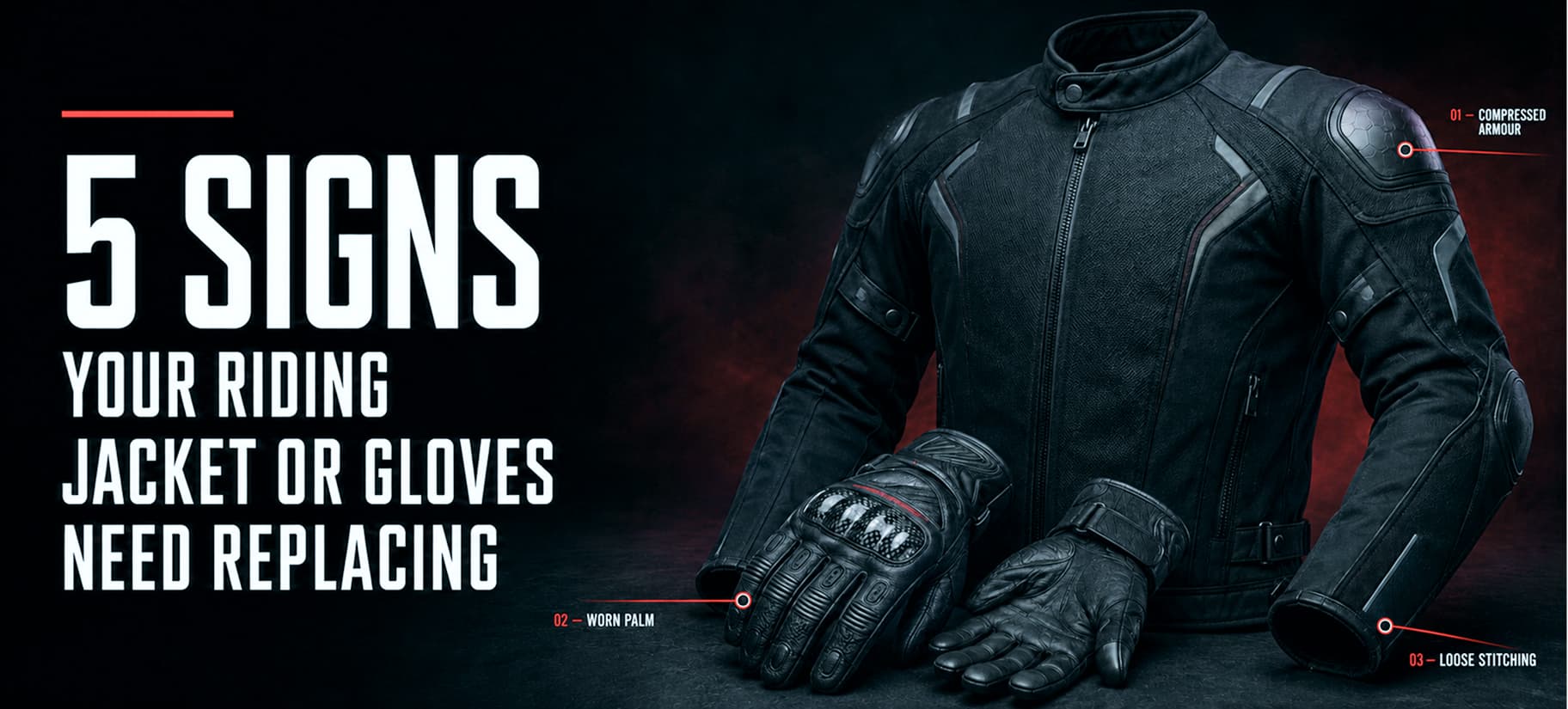
Your riding jacket or gloves need replacing when worn material, failed seams, loose armour, poor fit, or crash damage can no longer protect you properly. In our editorial review of safety and manufacturer guidance, condition and crash history mattered more than age.
If you're checking the signs your riding jacket needs replacing, start with the shell, seams, closures, and armour position. For gloves, inspect the palms, finger seams, wrist restraint, knuckle protection, and grip feel. You can compare replacement options in Throttlein's riding jacket collection, but inspect your current gear before buying anything.
Protective gear is a working safety system, not ordinary clothing. A jacket must resist abrasion, keep its protectors aligned, and stay closed during a slide. Gloves must remain on your hands while preserving throttle, brake, and clutch control. When one part fails, the whole item may stop doing its job.
Why does worn riding gear become unsafe?
Worn motorcycle gear becomes unsafe because protection depends on material strength, seam integrity, secure closures, correct fit, and armour placement. A jacket may look acceptable while weakened seams or loose armour reduce protection. Gloves may feel comfortable even when thin palms can tear quickly.
MotoCAP's testing process scores clothing for abrasion resistance, burst resistance, impact protection, and armour movement. Its impact test drops a 5 kg weight from 1 metre onto a protector.
The SATRA summary of EN 17092 covers five garment classes, AAA, AA, A, B, and C, within a six-part standard. It also tests seams, zips, protector pockets, sleeve restraint, tear strength, and abrasion resistance.
A certification label shows how new gear performed. It doesn't guarantee that old, sun-damaged, or crash-used gear still performs at the same level.
What are the 5 signs your riding jacket or gloves need replacing?
The five clearest warning signs are damaged outer material, failing seams or closures, degraded armour, changed fit, and crash-related damage. Replace the item when damage affects a high-risk area or can't be restored professionally. Cosmetic wear may be repairable, but structural weakness should never be treated as a style issue.
1. The outer material is thin, cracked, torn, or worn through
Visible material damage is one of the strongest signs your riding jacket needs replacing. Check shoulders, elbows, forearms, cuffs, and back panels. On gloves, inspect the heel of the palm, thumb web, fingertips, and finger bases.
Watch for fraying fibres, holes, peeling coatings, brittle textile, deep leather cracks, or an exposed inner layer. Light marks can be cosmetic. Material that feels thin, hard, or weak when flexed may no longer provide dependable abrasion resistance.
Waterproof failure alone doesn't always require replacement. A worn surface treatment may be restored. Persistent leaking, membrane delamination, or peeling internal layers point toward deeper failure. Throttlein's guide to waterproof motorcycle gloves for Indian monsoons explains the difference between coatings and waterproof membranes.
2. Seams, zips, Velcro, or wrist restraints no longer hold
A jacket or glove must stay closed during a slide. Open seams can expose skin. A separating main zip can open the jacket. A weak wrist strap may let a glove pull off during impact.
EN 17092 testing applies 100 N for 60 seconds to certain two-piece connections and 50 N for 30 seconds to sleeve restraints. These aren't home tests, but they show why closures count as structural safety parts.
Operate every zip and closure. Look for missing teeth, broken threads, fabric pulling away, weak hook-and-loop grip, or wrist straps that no longer tighten. The SATRA EN 13594 glove overview lists minimum restraint forces of 25 N for Level 1 gloves and 50 N for Level 2 gloves.
Structural motorcycle seams need a specialist repair. An ordinary fashion repair may look neat without restoring crash strength.
3. The armour or padding is cracked, compressed, or moving
Armour protects only when it covers the intended impact zone. An elbow protector that rotates toward the forearm may miss the elbow. The same rule applies to shoulder, back, knuckle, palm, and scaphoid protection.
Replace armour that is cracked, crumbling, permanently creased, unusually hard, sticky, or unable to recover after compression. Also inspect pockets, straps, and Velcro that hold it in place.
MotoCAP measures armour position and maximum displacement on a human model. Associate Professor Christopher Hurren, Chief Scientist for MotoCAP, recommends "at least two-star plus garments for city riding, and three-star plus garments for open road riding."
You can replace the armour without replacing the jacket when the shell, seams, pockets, restraints, and fit remain sound. Compare compatible rider protection gear, then confirm dimensions and certification.
4. The fit has changed and protection no longer stays aligned
Fit is a safety feature because it controls where protective zones sit. A stretched or loose jacket may let armour move. Gloves that have stretched can rotate, bunch under the palm, or reduce lever feel.
Common signs your gloves need replacing include excess material under the palm, loose fingertips, shifted knuckle armour, a wrist closure that can't tighten, or numb fingers caused by shrinkage and hardening.
Check jacket fit in the riding position. Bend your elbows, reach forward, and confirm the armour stays centred. Also check jacket overlap with trousers and riding gloves. Protective gaps often appear only after you sit on the bike.
5. The gear has been through a crash or serious slide
Crash involvement is one of the most urgent signs your riding jacket needs replacing and one of the clearest signs your gloves need replacing. Abrasion removes material. Impact can damage protectors. Seams and restraints may stretch without visibly breaking.
The official Alpinestars care guide says to inspect gear after a crash and advises, "Replace if in doubt."
Stop using the item when you find a hole, deep abrasion, melted textile, opened structural seam, torn armour pocket, cracked protector, damaged palm slider, or weakened wrist restraint. Fuel, oil, chemical, or biological contamination can also make replacement necessary.
A specialist may repair limited damage on premium gear. Until a qualified assessment confirms safety, treat crash-used gear as compromised.
How do jacket and glove warning signs differ?
Jackets usually fail through shell abrasion, weak seams, damaged closures, loose armour pockets, or poor torso and limb fit. Gloves fail faster at palms, fingertips, thumb joins, wrist restraints, and knuckle protection. Jacket damage threatens body coverage, while glove damage can also reduce immediate motorcycle control.
Inspection area | Jacket warning sign | Glove warning sign | Likely action |
Outer material | Thin elbows, torn mesh, cracked leather | Worn palms, holes, split fingertips | Replace if the protective layer is exposed |
Seams | Open shoulder, sleeve, or armour-pocket seam | Broken palm, finger, or thumb seam | Specialist repair only if damage is minor |
Closures | Main zip separates, cuff won't hold | Wrist strap releases or can't tighten | Replace or use approved specialist repair |
Armour | Elbow, shoulder, or back protector moves | Knuckle or palm protector shifts | Replace armour or whole item |
Fit | Jacket rides up or armour rotates | Glove twists, bunches, or numbs fingers | Replace with the correct size |
Crash history | Abrasion, stretched seams, hidden impact damage | Palm slide damage or restraint load | Inspect professionally, replace when uncertain |
Jacket cuffs should not push glove armour out of place. Gauntlet gloves must close securely over or under the sleeve. Complete the system with proper riding boots and protective trousers.
Should you repair or replace damaged riding gear?
Repair is reasonable when damage is minor, local, and outside the main protective structure. Replace gear when abrasion reaches a protective layer, a structural seam opens, armour can't stay aligned, or crash damage remains uncertain.
Use this decision rule:
Repair may be reasonable when
A replaceable zip pull has broken but the teeth and tape remain sound
A removable liner needs repair
Surface leather is dry but not cracked through
A non-structural pocket has opened
Replaceable armour is damaged while its pocket and shell remain intact
Replacement is usually safer when
Material has worn through at the shoulder, elbow, palm, or fingers
Structural seams separate or surrounding fabric tears
A main zip, cuff, or glove restraint can't stay closed
Armour pockets are stretched, torn, or badly positioned
The jacket or gloves no longer fit securely
Crash damage affects more than one protective zone
When comparing replacement jackets, use certification, fit, ventilation, and armour coverage together. Throttlein's top riding jackets guide provides a practical starting point for Indian riders.
How can you inspect your gear in five minutes?
A five-minute inspection works because most dangerous wear appears at predictable stress points. Check your gear in bright light, flex the materials, test every closure, and wear the items in a riding position. Repeat the check monthly, before a long tour, after heavy monsoon use, and after any fall.
Follow this routine:
Check the history: Note any fall, slide, hard impact, chemical spill, or long damp storage.
Scan the shell: Look at shoulders, elbows, cuffs, back, palms, thumb webs, and fingertips.
Test every closure: Operate zips, snaps, hook-and-loop panels, buckles, and wrist straps.
Inspect seams: Gently flex each seam and look for gaps, broken threads, or fabric pulling away.
Check armour: Remove it where possible, then inspect its shape, surface, and pocket.
Wear the gear: Sit in your normal riding posture and confirm that protectors remain aligned.
Test control: Grip a handlebar or similar tube and operate imaginary brake and clutch levers.
Smell and feel: Persistent mould, chemical odour, sticky foam, or brittle fabric may signal deeper damage.
Don't perform aggressive pull tests that could weaken usable gear. The goal is to find warning signs, not simulate a certification laboratory.
How can you make riding jackets and gloves last longer?
Good maintenance reduces damage from sweat, grit, UV exposure, moisture, and incorrect washing. It can't reverse structural wear. Follow the care label because leather, mesh, waterproof membranes, and impact protectors need different treatment.
Practical habits include:
Air jackets and gloves after every sweaty or wet ride
Dry them away from direct sun, heaters, exhausts, and hot engines
Remove road grit before it cuts fibres or stitching
Condition leather with a suitable product after cleaning
Avoid bleach, fabric softener, harsh solvents, and random waterproof sprays
Store gear dry, supported, and away from rodents or sharp objects
Clean hook-and-loop closures so they grip fully
Inspect before and after monsoon season
Never store gloves crushed inside a damp helmet
Alpinestars recommends a deeper inspection of seams, zip sliders, hook-and-loop closures, reflective panels, and armour pockets each year. For riders who commute daily in Indian heat or monsoon rain, a monthly visual check is more practical.
Your jacket and gloves are only two parts of the kit. Review the complete riding gear checklist for commuters and tourers so worn boots, trousers, or protectors don't become the weak link.
Conclusion
The key takeaway is simple: replace your riding jacket or gloves when damage affects their ability to resist abrasion, stay closed, hold armour in position, fit securely, or recover from a crash. Don't wait for a large hole. Protective gear often gives smaller warnings first. A palm becomes polished and thin. A finger seam starts opening. An elbow protector rotates when you bend your arm. A wrist strap reaches its limit but still feels loose. These details may look minor in the garage, yet they decide whether the gear stays between you and the road.
Start with a five-minute inspection under bright light. Check the highest-risk areas, flex the material, test every closure, remove and inspect the armour, then wear the gear in your normal riding posture. If a defect affects a structural seam, protective panel, restraint, or armour pocket, stop using the item until a qualified specialist assesses it. Repair makes sense for limited, non-structural faults. Replacement makes more sense when material has worn through, closures can't hold, protectors move, fit has changed, or the item has suffered serious crash damage. There is no universal replacement age that overrides these condition-based signs.
For your next purchase, choose certified gear that fits your body and riding conditions. Check the jacket with your gloves, trousers, and boots as one connected system. A strong jacket paired with loose gloves still leaves a weak point. Browse verified motorcycle riding gear on Throttlein, compare protection features carefully, and retire damaged gear before your next highway ride or long tour. The best time to replace compromised protection is before you need it.