
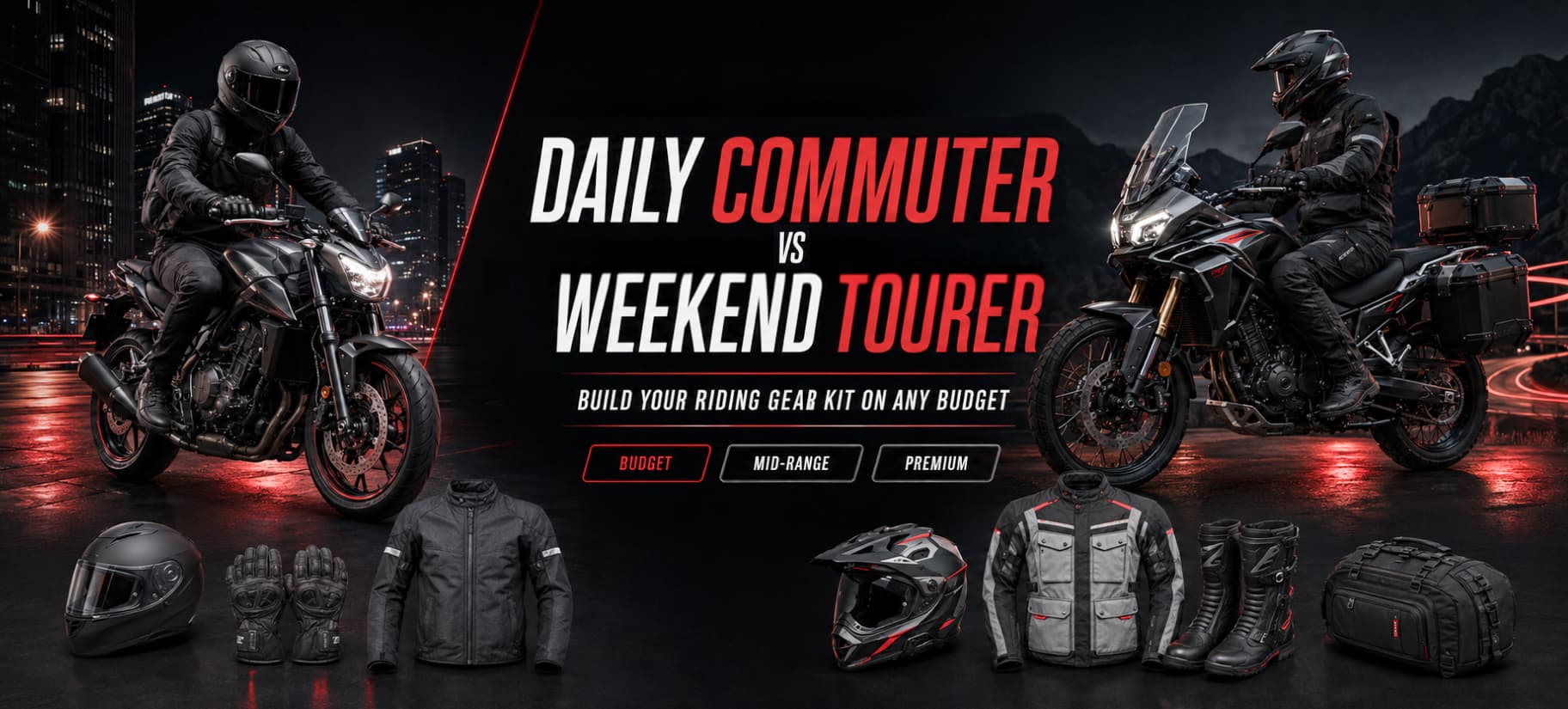
Building your riding gear kit starts with one honest question: how do you actually ride? A daily commuter needs lightweight, breathable, quickly wearable protection that holds up to stop-and-go traffic and Indian summer heat. A weekend tourer needs weather-versatile, fatigue-reducing gear that stays comfortable across 400-plus kilometres of highway. The good news is you don't need an unlimited budget for either. You need the right priorities in the right order. Whether you're spending ₹8,000 or ₹80,000, Throttlein carries certified gear for both riding styles across every category, from helmets and jackets to luggage and rider protection, so you can build your complete kit in one place without second-guessing seller credibility.
India recorded over 20 million two-wheeler registrations in 2025 alone (MarkNtel Advisors, 2026), and helmets contributed 25.01% of the riding gear market share globally that year, confirming their status as non-negotiable safety basics (Mordor Intelligence, 2026). Yet most riders in India still build their gear kit reactively, buying a helmet because it's legally required and adding everything else only after a close call. This guide flips that approach. It gives you a structured, budget-aware framework for building a complete riding gear kit, whether you ride six kilometres to the office every morning or 600 kilometres to Coorg every weekend.
Why Your Riding Style Determines Every Gear Decision
Your riding style is the single variable that should drive every purchase in your gear kit. This matters because commuter gear and tourer gear are optimized for fundamentally different challenges, and buying the wrong type wastes money while leaving real protection gaps.
A daily commuter in Bengaluru or Mumbai deals with low speeds, heavy traffic, extreme heat, and daily repetition. The priority is gear you'll actually wear every single day without resenting it. That means light, ventilated, and practical, with protection that doesn't add 15 minutes to your morning routine.
A weekend tourer on a Royal Enfield Himalayan or a Bajaj Dominar 400 deals with a completely different set of conditions: highway speeds above 80 km/h, sudden weather changes, long hours in the saddle, and remote stretches where an incident is far from medical help. The priority is gear that protects in high-energy crashes, manages heat and rain over hours, and doesn't cause fatigue before you reach your destination.
Both riders benefit from certified gear. Both need a helmet, a jacket, gloves, and protection. But the specification, weight, and features of each item differ significantly. Recognizing which rider you are, or which you are on which day, is where building a smart gear kit begins.
The Foundation Every Rider Needs Regardless of Budget
Before splitting into commuter and tourer recommendations, there are four items every rider in India needs. No budget level, no riding style, and no distance makes these optional.
1. An ISI-Certified Helmet
Every rider on Indian roads is legally required to wear an ISI-certified helmet under IS 4151:2015. A certified helmet reduces your risk of death in a crash by approximately 37% and reduces brain injury risk by around 69% (NHTSA data, via SupportBikers, 2026). Nothing in your gear kit is more important than this.
Entry-level ISI-certified full-face helmets start at around ₹1,200 from brands like Studds and Steelbird. Mid-range ISI plus ECE 22.06 dual-certified helmets from brands like SMK, Axor, and LS2 start at around ₹4,000 and represent the best value upgrade available in Indian gear. Browse the full range of verified certified helmets at the Throttlein helmets and accessories section.
2. A Jacket with Certified Armor
A riding jacket is not a fashion item. It's your second layer of protection after your helmet and the item most likely to prevent road rash, fracture, and soft tissue injury in a slide or fall. CE Level 1 or Level 2 certified armor at the shoulders, elbows, and back is what you're looking for.
Budget jackets with CE-rated armor start at ₹2,500 from brands like BBG and Rynox. Mid-range options with better ventilation and armor coverage run ₹4,000 to ₹8,000. Premium touring jackets with waterproof membranes and multiple armor slots go from ₹8,000 to ₹20,000 and above.
3. Gloves with Knuckle Protection
Hands are among the most commonly injured body parts in motorcycle crashes because riders instinctively extend arms during a fall. A pair of CE-certified riding gloves with knuckle armor and palm sliders is a ₹800 to ₹2,500 investment that provides meaningful protection a bare hand cannot. Check certified options in the rider protection section on Throttlein.
4. A Phone Mount for Navigation
This is practical safety, not just convenience. Reaching into a pocket for a phone while riding is a genuine hazard. A secure phone mount with vibration dampening and a secondary safety tether puts navigation at eye level and keeps both hands on the bars. Budget mounts start at under ₹500. Check mobile holders on Throttlein for verified options compatible with your bike's handlebar.
Building the Daily Commuter Gear Kit
A daily commuter's gear kit is built around one core principle: gear you'll wear every ride, every day, without excuses. The best commuter gear is the gear that doesn't feel like a burden at 7:30 in the morning on a 35-degree Delhi summer day.
The Commuter Helmet: Ventilation Beats Weight Class
For daily commuting in Indian cities, a full-face helmet with ISI certification and a strong ventilation system is the right starting point. Modular helmets are a popular alternative for commuters who wear glasses or make frequent stops, because the flip-up chin bar allows quick access without full removal.
Weight matters more for commuters than for tourers because you're putting it on and taking it off multiple times a day. Look for a helmet under 1,400 grams. Ventilation matters because you're sitting in traffic in Indian heat, not cruising at 100 km/h on an open highway where airflow keeps temperatures manageable.
Budget tier (₹1,200 to ₹3,500): ISI-certified full-face from Studds, Steelbird SBH-17, or Vega Crux. Adequate legal protection for low-speed urban riding.
Mid-range tier (₹3,500 to ₹7,000): ISI plus ECE 22.05/22.06 from Axor Apex Venom or SMK Twister. Better ventilation, lighter shell, improved liner quality.
Premium tier (₹7,000 to ₹15,000): ISI plus ECE 22.06 from LS2 FF800 Storm or MT Thunder 4 SV. Multi-channel ventilation, sub-1,350 gram shells, Pinlock anti-fog visor standard.
The Commuter Jacket: Mesh is Your Friend
For Indian city commuting, a mesh jacket is almost always the right call between March and October. Mesh panels allow genuine airflow that textile jackets can't match in traffic, and the difference between a mesh jacket and a solid textile jacket at a standstill in Mumbai summer heat is the difference between wearing it every day and leaving it in the bag after the second week.
Look for CE Level 1 armor at shoulders and elbows, a back protector slot (some budget jackets include a foam insert rather than a CE-rated back protector; upgrade the insert separately if needed), and adjustable waist and sleeve cuffs. A reflective strip at the back is a meaningful safety addition for early morning and evening commutes.
Browse CE-certified riding jackets on Throttlein, where mesh, textile, and leather options are organized by riding type so you're not sorting through touring gear when you need a commuter jacket.
Budget tier (₹2,500 to ₹5,000): BBG Motor Jacket, Rynox Air GT Jacket. CE Level 1 armor, basic mesh ventilation.
Mid-range tier (₹5,000 to ₹9,000): Rynox Tornado Pro, ViaTerra Corsa. Better mesh coverage, detachable liner for cooler mornings.
Premium tier (₹9,000 to ₹18,000): Axor Hawk, Dainese Air Fast. Full CE Level 2 armor, ergonomic cut, multi-season adaptability.
The Commuter Bag: Practical Carrying Without the Hassle
Most daily commuters carry a laptop, documents, and a lunch box. A dedicated riding backpack with a chest strap and hydration port is significantly safer than a standard bag because it stays on your back during a fall rather than swinging forward. Look for options between 15-25 litres with a water-resistant outer shell.
Tank bags and tail bags are useful additions once you're beyond the minimum kit. A small tank bag puts your phone, wallet, and daily essentials at arm's reach without stopping. Browse verified bags and backpacks on Throttlein for options suited to daily commuting distances and Indian road conditions.
The Commuter Knee Guard: The Underrated Essential
Most commuters skip knee protection entirely, which is a genuine risk given how often city riding involves near-misses at low speed with pedestrians and vehicles pulling out of lanes. Soft-shell CE Level 1 knee guards that slip under regular riding pants or jeans start at around ₹800 and add meaningful protection for a very small daily wearability cost.
Full Commuter Kit Budget Summary
Item | Budget Build | Mid-Range Build | Premium Build |
Helmet | ₹1,200 to ₹3,500 | ₹3,500 to ₹7,000 | ₹7,000 to ₹15,000 |
Jacket | ₹2,500 to ₹5,000 | ₹5,000 to ₹9,000 | ₹9,000 to ₹18,000 |
Gloves | ₹800 to ₹1,500 | ₹1,500 to ₹3,500 | ₹3,500 to ₹6,000 |
Knee guards | ₹800 to ₹1,500 | ₹1,500 to ₹3,500 | ₹3,500 to ₹8,000 |
Phone mount | ₹400 to ₹800 | ₹800 to ₹1,500 | ₹1,500 to ₹3,000 |
Total | ₹5,700 to ₹12,300 | ₹12,300 to ₹24,500 | ₹24,500 to ₹50,000 |
Building the Weekend Tourer Gear Kit
A weekend tourer's gear kit is built around a different core principle: gear that keeps you safe and functional for 6-10 hours of continuous riding across changing terrain and weather, with enough carrying capacity to be self-sufficient.
The key difference from commuter gear is not that tourer gear needs to be more expensive. It's that tourer gear needs to handle a wider range of conditions, sustain protection at higher speeds, and manage fatigue across longer periods. A ₹5,000 commuter mesh jacket is excellent for city riding. At 100 km/h on a highway for four hours, you'll feel the difference compared to a proper touring textile with waterproofing and back protector.
The Tourer Helmet: Weight, Protection, and Wind Noise
For touring, a full-face helmet is non-negotiable. The wind blast at highway speeds makes open-face helmets exhausting within an hour and provides no chin protection in a highway crash.
Key tourer helmet priorities are weight (under 1,400 grams to reduce neck fatigue over 6+ hours), ECE 22.06 certification for the best rotational impact testing available, and wind noise management. A helmet with effective sealing around the neck roll and quality cheek pads significantly reduces the wind fatigue that builds across a long day of riding.
A Pinlock anti-fog insert is worth the additional cost for any tourer because morning starts and rain-prone conditions on Indian highways regularly create fogging that's dangerous at speed. Many LS2 and SMK helmets in the ₹5,000 to ₹12,000 range include Pinlock-ready visors.
For adventure riders on bikes like the Royal Enfield Himalayan, KTM 390 Adventure, or BMW G 310 GS, a dual-sport helmet with peak visor and extended chin bar is the right choice. It handles highway speeds and off-road sections equally well.
The full verified range is available at Throttlein's helmets and accessories section, organized by helmet type so adventure and touring options are easy to find.
The Tourer Jacket: Weather Versatility is the Priority
A touring jacket needs to work in three different scenarios: hot and dry, hot and rainy (India's monsoon season makes this a regular reality), and cool mornings and evenings on high-altitude passes.
The practical solution is a textile jacket with a removable waterproof inner membrane and detachable thermal liner. This single jacket covers all three scenarios without needing to carry three different jackets. Good examples in the Indian mid-range include the Rynox Stealth Pro, ViaTerra Leh, and Axor Dominator.
CE Level 2 back protection is worth the upgrade for touring over Level 1. The back is your most vulnerable area in a high-speed crash, and the additional energy absorption of a Level 2 protector is meaningful when the impact energies are higher. Check for the back protector slot and confirm the included protector's CE rating before assuming it's adequate.
Budget tier (₹5,000 to ₹10,000): Rynox Air GT or Rynox Helium. Good mesh coverage, removable liner, CE Level 1 armor. Suitable for fair-weather touring below 1,000 metres altitude.
Mid-range tier (₹10,000 to ₹20,000): Rynox Stealth Pro, ViaTerra Leh. Waterproof membrane, CE Level 1/2 armor, multiple ventilation zones. The right choice for monsoon touring and Himalayan rides.
Premium tier (₹20,000 and above): Dainese Springbok 3L, REV'IT! Outback. Full CE Level 2 armor, breathable waterproof membranes, adventure-ready construction.
The Tourer Luggage Setup: Plan by Capacity and Mount Type
Luggage is where the tourer's kit diverges most dramatically from the commuter's. A commuter needs one bag for daily carry. A tourer needs a system that can carry a weekend's worth of clothing, tools, a first aid kit, and rain gear without compromising the bike's handling.
The most practical entry-level touring luggage system combines a tail bag (20-35 litres) with a tank bag (5-15 litres with a clear map window). Saddlebags add 40-80 litres of additional capacity and are the right choice for Himalayan-style adventure touring where you need to carry camping equipment or gear for four or more days.
What to check before buying touring luggage:
Subframe compatibility: Most saddlebags require a rack or specific subframe mounting. Confirm your bike's subframe type before purchasing
Weatherproofing: Roll-top closure or a sealed zip with a rain cover is the minimum for Indian monsoon conditions
Quick-release system: You want to be able to remove and re-attach bags at checkpoints and hotels without tools
Weight distribution: Overpacked bags high on the rear raise the centre of gravity and affect handling. Load heavier items low and close to the centreline
Browse touring luggage and saddlebags on Throttlein with compatibility details listed for popular Indian bikes.
Crash Guards: The Most Cost-Effective Bike Protection for Tourers
For any tourer, especially on adventure bikes venturing onto unpaved roads, crash guards are one of the best-value investments in your kit. A quality set of crash guards costing ₹3,000 to ₹8,000 routinely prevents ₹15,000 to ₹40,000 worth of engine casing, panel, and footpeg damage from a low-speed tip-over on a remote trail or an overnight parking fall.
Check bike protection and crash guards on Throttlein and confirm model-year compatibility for your specific bike before purchasing.
Auxiliary Lighting: Not Optional for Highway Night Riding
Riding at night on Indian highways is genuinely dangerous without supplementary lighting. Unlit stretches, cattle on roads, and vehicles without tail lights are real hazards. A set of LED auxiliary lights rated at 30W per lamp with IP67 water resistance adds meaningful visibility for a ₹3,000 to ₹8,000 investment.
Explore verified lighting options on Throttlein with wiring harness compatibility for your bike's electrical system.
Bluetooth Communicators for Group Touring
Group riding without communication forces riders to rely on hand signals, which are easily missed in traffic and at speed. A Bluetooth communicator with group intercom lets you stay connected with your riding group, receive navigation audio, and take calls without stopping.
Entry-level Bluetooth intercom units start at around ₹3,000 for single-unit pairing. Multi-rider mesh intercom systems suitable for groups of five or more start at ₹6,000 to ₹12,000 and offer ranges of 1 to 1.6 km. Browse Bluetooth communicators on Throttlein for options that work with your existing helmet model.
Full Tourer Kit Budget Summary
Item | Budget Build | Mid-Range Build | Premium Build |
Helmet | ₹4,000 to ₹7,000 | ₹7,000 to ₹12,000 | ₹12,000 to ₹25,000 |
Jacket | ₹5,000 to ₹10,000 | ₹10,000 to ₹20,000 | ₹20,000 to ₹40,000 |
Gloves | ₹1,500 to ₹3,000 | ₹3,000 to ₹6,000 | ₹6,000 to ₹12,000 |
Riding pants/knee guards | ₹2,000 to ₹5,000 | ₹5,000 to ₹10,000 | ₹10,000 to ₹20,000 |
Luggage system | ₹3,000 to ₹7,000 | ₹7,000 to ₹15,000 | ₹15,000 to ₹35,000 |
Crash guards | ₹2,500 to ₹5,000 | ₹5,000 to ₹8,000 | ₹8,000 to ₹15,000 |
Auxiliary lighting | ₹2,500 to ₹4,000 | ₹4,000 to ₹8,000 | ₹8,000 to ₹15,000 |
Bluetooth communicator | ₹2,500 to ₹4,000 | ₹4,000 to ₹8,000 | ₹8,000 to ₹15,000 |
Total | ₹23,000 to ₹45,000 | ₹45,000 to ₹87,000 | ₹87,000 to ₹177,000 |
The Smart Build Order: What to Buy First on a Tight Budget
If you can't buy everything at once, here's the right order to build your kit, regardless of riding style.
Priority 1 (Buy first, non-negotiable):
ISI-certified helmet
CE-certified riding jacket with armor
Riding gloves with knuckle protection
Priority 2 (Buy next, significant safety upgrade): 4. Knee and back protection 5. Phone mount for navigation 6. Rain gear (poncho minimum; dedicated riding rain suit for tourers)
Priority 3 (Add as budget allows): 7. Riding boots or ankle-protecting shoes 8. Luggage that fits your trip length 9. Crash guards for bike protection 10. Auxiliary lighting and Bluetooth for tourers
This ordering prioritizes your body first, then your bike, then your convenience and electronics. Riders who buy a crash guard before a proper jacket are spending money in the wrong order.
How Riding Dual Purpose (Both Commuting and Touring) Changes Your Kit
Many Indian riders are both: a daily commuter Monday through Friday and a weekend tourer on Saturday and Sunday. If that's you, you don't need to buy two complete kits.
The smart overlap strategy:
Helmet: Buy a mid-range ISI plus ECE 22.06 full-face that works for both. It's good enough for commuting and adequate for most touring. Upgrade to a dedicated touring helmet with better wind noise management when budget allows
Jacket: A quality mid-range textile jacket with a removable mesh inner works for both uses better than a dedicated mesh commuter jacket ever will. It's slightly warmer on city commutes but handles highway touring and rain
Gloves: One pair of touring-spec gloves doubles as a commuter glove without compromise
Luggage: A quality 20-25 litre tank bag with quick-release covers daily commuter carry and weekend tourer essentials. Add a tail bag for longer trips
The one item worth having two of, if budget allows, is a jacket. A dedicated lightweight mesh jacket for summer city commuting and a waterproof textile jacket for touring will each perform better in their respective roles than any single jacket can.
Conclusion: The Gear Kit That Matches Your Ride
The single most important insight across this entire guide is this: the best riding gear kit is not the most expensive one. It's the one that's correctly matched to how you ride, certified to a standard that protects you at those riding speeds and conditions, and complete enough that you actually wear all of it every time you get on the bike.
A daily commuter who owns a ₹6,000 ISI-certified mesh jacket kit they wear every single day is better protected than a weekend rider who owns ₹40,000 worth of touring gear they leave at home because it's too much effort for a short run.
Build your kit in the right order: helmet first, jacket second, gloves third. Then add knee protection, phone mount, and luggage that suits your trip length. If you ride both ways, invest in the single jacket that bridges both uses rather than buying the cheapest version of two separate jackets.
India's ride gear market is growing from USD 202 million in 2025 toward USD 314 million by 2032 (MarkNtel Advisors, 2026). More riders every year are investing in proper certified gear, and the accessible price points for quality protection have never been better. A complete, certified commuter kit starts from under ₹12,000. A capable budget tourer kit starts from around ₹23,000. Neither requires compromising your safety to make the budget work.
Start building your kit today at Throttlein, where every seller is verified, every category is rider-specific, and the full range from budget to premium is available in one place. Begin with helmets, add a jacket and rider protection, then complete your setup with the luggage, bike protection, and lighting your riding style actually needs.