
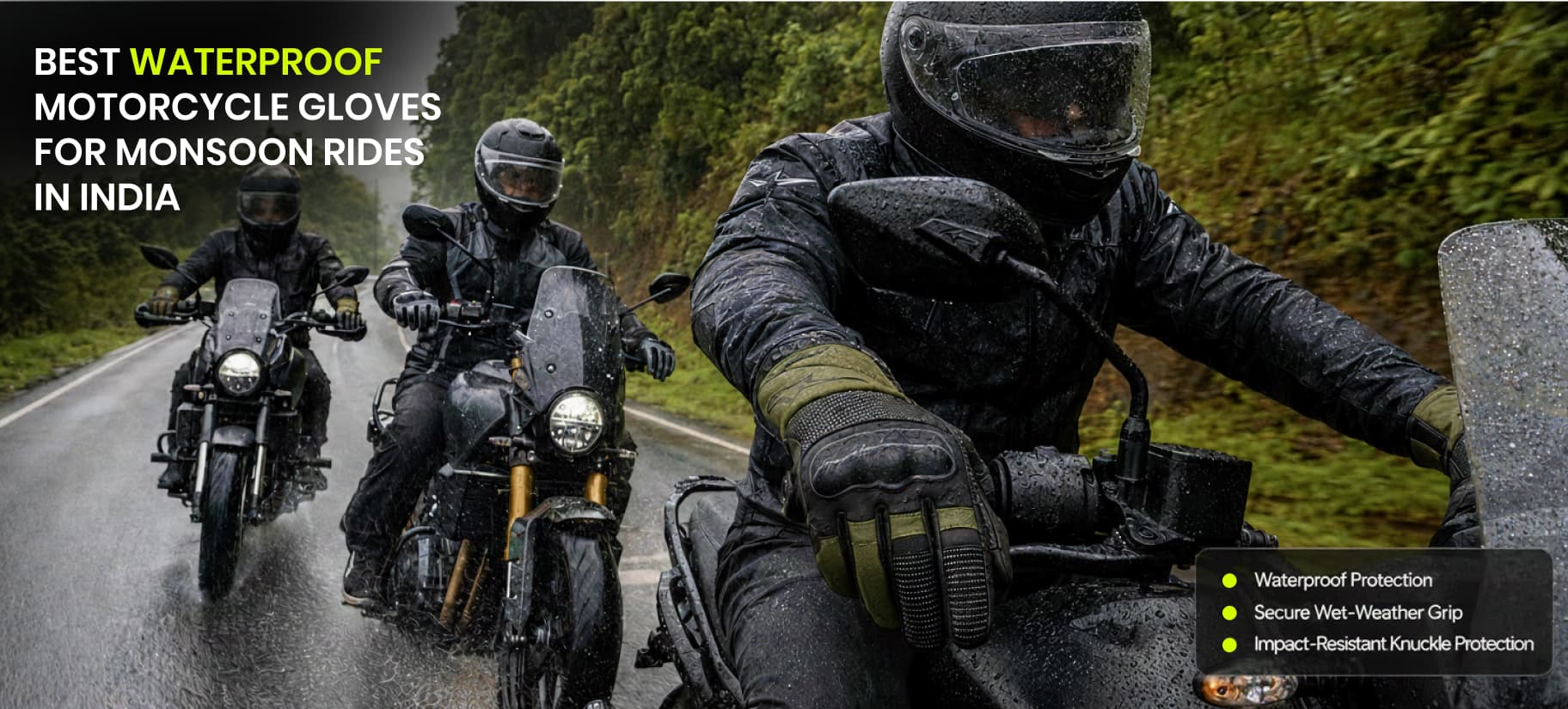
The best waterproof motorcycle gloves for monsoon rides in India combine a fully sealed waterproof membrane (not just a water-resistant coating), CE certification under EN 13594:2015, a gauntlet cuff long enough to seal against your jacket sleeve, and enough breathability to prevent sweat buildup during India's humid riding conditions. Options like the Alpinestars Andes V3 Drystar, the Klim Badlands GTX, and the Tucano Urbano Hydrawarm sit at the top of most rider shortlists in 2026 for exactly those reasons. This guide explains what to look for, how each key feature performs in Indian monsoon conditions, and how to make sure your gloves actually protect you when the rain arrives at 120 km/h on the highway.
Your hands are your most important contact points with any motorcycle. They control the throttle, brake, and clutch simultaneously, and in any crash, they hit the ground first. A 2025 NHTSA rider safety study confirms that hand and wrist injuries are among the most common in motorcycle crashes because riders instinctively brace against impact. In India, where monsoon season runs from June through September across most of the country, wet hands are also a control problem, not just a comfort one. Cold, wet hands lose the muscle precision required to modulate a progressive brake lever or feel clutch bite point accurately. The right pair of waterproof gloves is one of the highest-impact safety investments any Indian rider can make, and browsing the full rider protection range on Throttlein is a good starting point once you know what specifications to look for.
Why Do Indian Monsoon Conditions Demand Purpose-Built Waterproof Gloves?
Indian monsoon conditions demand purpose-built waterproof gloves because they create a combination of challenges that normal gloves, or even water-resistant gloves, simply can't handle: sustained heavy rainfall lasting hours, high humidity that prevents sweat evaporation, and temperatures typically between 25°C and 35°C that make heavily insulated gloves unbearable.
The Indian monsoon is not a light European drizzle. From June through September, the southwest monsoon delivers rainfall averaging 700-900 mm across the Deccan and up to 2,500 mm in Western Ghats regions (India Meteorological Department, 2025). When you're riding through this, rain doesn't just fall on your gloves. It cascades down your forearm from your jacket sleeve and enters from above unless your glove cuff seals correctly. It blows horizontally at speed, soaking exposed seams. It soaks through outer shells that have only a DWR (Durable Water Repellent) coating rather than a full waterproof membrane.
"Waterproof and water-resistant are not the same thing," as BikerRated's independent gear testing puts it. "A water-resistant coating on the outer leather or textile will only withstand a light shower. Your gloves are going to get wet. A quality waterproof membrane like Gore-Tex, Drystar, Outdry, or Hipora will prevent water getting into the glove but also allow airflow, so your hands will breathe and not get sweaty" (BikerRated, 2024).
For Indian riders, the breathability side of that equation matters just as much as the waterproofing side. If your gloves trap heat and sweat in 32°C monsoon temperatures, you'll want to remove them within 20 minutes. A glove that's waterproof but not breathable is miserable to wear in Indian summer-monsoon conditions.
What Features Define the Best Waterproof Motorcycle Gloves?
A great waterproof monsoon riding glove for India has six non-negotiable features and several secondary ones worth understanding before you spend money. Here's the breakdown:
1. A Fully Sealed Waterproof Membrane (Not Just a Coating)
This is the single most important distinction in waterproof glove buying. The membrane sits as a separate internal layer between the outer shell and the inner lining. When a glove's outer shell gets saturated, which it will in heavy rain, the membrane is what stops water reaching your hand.
The leading membranes used in quality motorcycle gloves are:
Gore-Tex: The benchmark. Independently tested, highly breathable, and backed by a performance guarantee. Gore-Tex also has a proprietary "Gore Grip" technology that bonds the liner to the outer shell, eliminating the floating liner sensation that causes reduced tactile feedback when wet
Alpinestars Drystar: Alpinestars' proprietary membrane that multiple independent reviewers, including RideAdv and BikerRated, rate as "about as reliable as Gore-Tex in outright protection, and only a little less breathable in the heat" (RideAdv, 2026)
Dainese D-Dry: Similar performance to Drystar, used across Dainese's touring and adventure glove range
Hipora: A budget-accessible waterproof membrane used by brands like Garibaldi and some Oxford models. Less breathable than Gore-Tex but genuinely waterproof
Hydratex (REV'IT!): REV'IT!'s in-house membrane, used in the Summit and Cassini H2O models, rated well for warmth and light-to-moderate rain protection
For Indian conditions, prioritize Gore-Tex or Drystar for the best breathability-to-waterproofing balance. In 30°C+ monsoon temperatures, a less breathable membrane creates a sweaty hand problem that erodes your control feel over long rides.
2. Gauntlet Cuff Length and Sealing System
The cuff is where most monsoon gloves fail in real Indian conditions. A short-cuff glove leaves a gap between your jacket sleeve and your glove. In sustained rain, water runs down your forearm and enters through that gap, soaking the interior from above even if the glove itself is perfectly waterproof.
A proper monsoon glove needs a full gauntlet cuff, typically 10-15 cm above the wrist, that can be worn either over or under your jacket sleeve. The Klim Badlands GTX and Alpinestars Andes V3 Drystar both feature adjustable gauntlet cuffs designed for this dual-position wearing (Gear Junkie, 2026). The cuff closure should include a hook-and-loop or drawstring system that creates a tight seal against water ingress from above.
CE Level 2 certification (EN 13594:2015 Level 2 KP) technically requires a minimum gauntlet length, which is why many CE Level 2 certified gloves are inherently better sealed for monsoon use than short-cuff alternatives.
3. CE Certification Under EN 13594:2015
CE certification under EN 13594:2015 is the European safety standard for motorcycle gloves, covering impact protection at the knuckles, abrasion resistance, tear strength, and retention system integrity. It has two levels:
Level 1 KP: The basic certification. Impact protection tested at a specific energy threshold. Suitable for touring and commuting
Level 2 KP: The stricter standard. Impact tested at higher energy and requires a gauntlet cuff length that provides better wrist coverage
For Indian monsoon riding, CE Level 1 KP is the practical minimum. Level 2 KP is worth the additional cost for riders who do regular highway riding, where crash speeds and impact forces are higher. Level 2 KP gloves also tend to be better sealed by design because the required cuff length inherently protects the wrist opening from water ingress.
4. Material: Leather vs Textile for Monsoon Use
Both leather and textile gloves can be waterproofed effectively, but they behave differently when wet and in monsoon conditions specifically.
Leather: Full-grain cowhide or goatskin leather is more abrasion-resistant and naturally conforms to your hand shape over time. However, leather absorbs water on its outer surface, becomes heavier when wet, and takes longer to dry than textile. In sustained monsoon rain, the outer leather shell will soak through and the glove will feel heavy, even if the interior membrane keeps your hand dry. Post-ride leather conditioning is essential to prevent cracking from repeated wet-dry cycles in monsoon season.
Textile (nylon, polyamide, Cordura): Textile gloves shed water from the outer shell more readily than leather and dry faster. They're generally lighter, and in 30°C+ Indian monsoon temperatures, the reduced mass matters for long-ride comfort. The trade-off is that abrasion resistance is lower than full-grain leather at equivalent price points.
For Indian monsoon conditions specifically, textile-outer gloves with waterproof membranes are often the more practical choice because they manage the wet-dry cycle better in the high humidity that persists even between rain showers.
5. Touchscreen Compatibility
This is a secondary feature but practically important for Indian riders who use smartphones for navigation. Removing a waterproof glove in monsoon rain to operate a GPS is both inconvenient and risky (wet, glove-free hands on a wet throttle). Most quality waterproof gloves in 2025-2026 include conductive fingertips on at least the index finger, and often the thumb as well.
6. Visor/Helmet Wiper
Many monsoon-oriented gloves include a squeegee-style visor wiper on the left thumb. In heavy rain, this is a genuinely useful feature that allows you to clear your visor without stopping or fumbling with your helmet.
Waterproof Membrane Comparison for Indian Riding Conditions
Membrane | Brand | Breathability | Waterproof Level | Indian Monsoon Suitability | Price Tier |
Gore-Tex + Gore Grip | Various (Klim, Five, Held) | Highest | Excellent | Best, especially for sustained rain | Premium (₹12,000+) |
Alpinestars Drystar | Alpinestars | High | Excellent | Excellent, near Gore-Tex performance | Mid-premium (₹8,000-₹15,000) |
Dainese D-Dry | Dainese | High | Excellent | Excellent | Mid-premium (₹9,000-₹18,000) |
REV'IT! Hydratex | REV'IT! | Moderate-High | Good | Good for short-to-medium rain exposure | Mid-range (₹6,000-₹12,000) |
Hipora | Garibaldi, Oxford, others | Moderate | Good | Good for monsoon, warm in high temps | Budget-mid (₹3,500-₹8,000) |
DWR coating only | Various budget brands | N/A | Light shower only | Insufficient for monsoon use | Budget (below ₹2,500) |
Best Waterproof Motorcycle Gloves for Monsoon Rides in India: Top Picks by Riding Type
Throttlein currently focuses on protective gear including rider protection and riding jackets, so for the waterproof glove models below, use the brand names to search authorized Indian retailers. Do not purchase from unverified sellers, since CE certification counterfeiting is a real issue in Indian gear markets.
Best for Highway and Touring Riders
Alpinestars Andes V3 Drystar The Andes V3 is consistently rated among the top waterproof touring gloves by GearJunkie, Motorcycle Gear Advice, and Indian rider community forums for Southeast Asian and South Asian conditions. The Drystar membrane provides excellent rain protection in sustained downpours, the mid-gauntlet cuff seals against jacket sleeves, and TPU knuckle protection with palm padding delivers CE Level 1 KP coverage. The pre-curved finger construction reduces fatigue on long rides. Weight and bulk are appropriate for India's 30-35°C monsoon temperatures.
Klim Badlands GTX For adventure touring riders on bikes like the Royal Enfield Himalayan or KTM Adventure series, the Klim Badlands GTX is one of the most consistently reviewed gloves in its class globally. Gore-Tex waterproofing with Gore Grip eliminates the floating-liner problem, Thinsulate on the back of the hand takes the edge off cooler highland monsoon temperatures, and Poron XRD knuckle armor delivers high-energy impact absorption. The visor wiper on the left thumb is a practical monsoon feature. At its price point it's a premium investment, but for riders who spend 500+ km days in the monsoon, the sustained waterproofing holds up where cheaper options fail.
Best for City Commuters
REV'IT! Summit 4 H2O The Summit series has earned a strong reputation for durability in daily commuter use. Independent testing at Motorcycle News UK found these gloves stayed waterproof through sustained heavy showers with a snug wrist adjuster that seals against the sleeve gap. The moulded knuckle protection and scaphoid protection at the palm heel make these suitable for traffic stop-and-go conditions where urban crash scenarios are most common. The Hydratex membrane is not as breathable as Gore-Tex but performs acceptably in Indian monsoon temperatures.
Five TFX1 GTX For commuters who want CE Level 2 KP protection in a waterproof package, the Five TFX1 GTX is one of the few gloves that delivers both. Gore-Tex lining, full-gauntlet cuff, and a stretch-textile dorsal that moves freely with finger and knuckle movement. At India's typical monsoon temperatures above 25°C, the uninsulated Gore-Tex construction keeps hands dry without overheating.
Best All-Rounder for Mixed Riding
Held Air N Dry GTX II The Held Air N Dry's dual-chamber design is the most practical solution for Indian riders who encounter both dry summer heat and sudden monsoon downpours on the same ride. The outer Breezy chamber is unlined and ventilated for dry hot-day riding. The inner Dry chamber adds a Gore-Tex liner that provides full waterproofing when the monsoon arrives. Held offers up to 30 sizing combinations by hand length and width, which addresses one of the common fit problems with mass-market gloves for Indian hand shapes. CE Level 1 KP certified.
What Are the Most Common Monsoon Glove Mistakes Indian Riders Make?
Getting the right waterproof gloves means avoiding the errors that most Indian riders encounter in their first or second monsoon season with new gear.
Mistake 1: Buying DWR-coated gloves instead of membrane gloves A "water-resistant" glove with only a DWR (Durable Water Repellent) coating on the outer shell will handle a 10-minute light drizzle. It will not handle a two-hour Indian monsoon downpour. After the outer material saturates, water transfers straight through to your hands within minutes. Always confirm a sealed internal membrane is present in the glove's construction.
Mistake 2: Short cuffs in monsoon season Short-cuff waterproof gloves leave the wrist-jacket sleeve interface open. In sustained rain, water runs down your sleeve and enters from the top, soaking the glove interior even if the glove itself is perfectly waterproof. A full gauntlet cuff that can be worn over the jacket sleeve eliminates this path entirely.
Mistake 3: Not pairing gloves with a monsoon-ready jacket Even the best waterproof gloves can't compensate for a jacket that funnels water down your forearm. Your monsoon riding jacket should have sealed or covered cuffs that work in conjunction with your glove's gauntlet seal. A jacket with an open, unlined cuff wicking water toward your gloves defeats the gloves' own waterproofing at the sealing point.
Mistake 4: Not maintaining the DWR layer on the outer shell Even membrane gloves rely on the outer shell's DWR treatment to prevent excessive water absorption. When the DWR degrades (after 20-30 washes or 12-18 months of regular use), the outer shell wets out and becomes heavy even though the membrane still keeps your hand dry. Reapplying Nikwax TX.Direct or a similar DWR treatment to the outer shell restores the glove's outer water-shedding performance.
Mistake 5: Ignoring glove-to-jacket integration This is a system problem. Your riding jacket, your gloves, and your helmet all need to work together as a system in monsoon conditions. A jacket with integrated wrist velcro closures, gloves with gauntlet cuffs that seal over those closures, and a helmet with a tight visor seal creates a coherent wet-weather barrier. Treating each piece of gear as independent reduces your total protection.
How to Care for Waterproof Motorcycle Gloves After Monsoon Riding
Waterproof gloves deteriorate faster without proper post-monsoon care. This is the maintenance routine that extends both the waterproofing performance and the CE protection lifespan of your gloves:
After each monsoon ride:
Rinse the outer shell with clean cold water to remove road grime and road salt, both of which degrade DWR treatments faster than rain alone
Turn the gloves inside out if possible and rinse the liner as well
Air dry away from direct sunlight and heat sources. Do not place on a radiator, engine cover, or in direct sun. UV and heat both degrade membrane integrity over time
Once fully dry (usually 24 hours for membrane gloves), check for any DWR bead-off. If water no longer beads on the outer shell, treat with a DWR restorer
Every 2-3 months of monsoon use:
For leather gloves, apply motorcycle-grade leather conditioner once completely dry. Monsoon cycles of wet-dry without conditioning crack leather at the knuckle creases and palm seams
For textile gloves, machine wash at 30°C with no fabric softener (softener blocks the DWR treatment) and tumble dry on low or air dry
Inspect the cuff velcro or drawstring system for debris that reduces seal quality. Clean velcro with a stiff brush
Your full riding safety kit, including knee guards and back protectors, benefits from the same post-monsoon care routine. Moisture trapped in EPS foam inserts degrades their impact absorption performance over time just as it does in helmet liners.
How Should Waterproof Monsoon Gloves Fit?
Fit is where even a well-reviewed glove can fail in practice. A glove that's too large allows the palm to rotate in an impact, exposing the knuckles at exactly the moment the armor needs to be in position. A glove that's too tight restricts blood flow and accelerates hand fatigue on long rides.
How to size motorcycle gloves correctly: Measure your dominant hand's circumference around the knuckles (not including the thumb) and your hand length from the base of the palm to the tip of your middle finger. Cross-reference both measurements against the specific brand's size chart. Never use only an S/M/L designation to size gloves, because sizing systems differ substantially between European, Japanese, and Indian brands.
A correctly fitted glove should feel snug on the hand with all fingers reaching fully into the fingertips. The palm area should not have excess material that bunches. The thumb should sit naturally in its position. Close your fist fully: if the glove restricts this movement or feels like it might pull off the heel of the hand, it's either too small or too short in the finger lengths.
If you wear gloves alongside CE-certified body armor on your forearms, size the gloves to accommodate the armor cuff beneath the gauntlet, not against bare skin.
Conclusion: Your Hands Control the Bike. Protect Them for Every Monsoon Ride.
The most important thing to take away from this guide is one fact: no matter how good your helmet or jacket is, wet, numb hands without proper gloves are a real danger on Indian roads in monsoon season. Hands control the throttle, brakes, and clutch. When they're cold, wet, and fatigued from poor-quality gloves, your reaction time and precision both drop, and that's the direct path to a preventable crash.
The best waterproof motorcycle gloves for monsoon rides in India share four qualities: a fully sealed waterproof membrane (Gore-Tex or equivalent), a full gauntlet cuff that seals against your jacket sleeve, CE certification under EN 13594:2015, and enough breathability to stay wearable in 30-35°C Indian monsoon temperatures. The Alpinestars Andes V3 Drystar and Klim Badlands GTX lead for touring and adventure riders. The REV'IT! Summit 4 H2O works well for daily commuters. The Held Air N Dry GTX II is the most versatile single-pair solution for mixed-weather riding across a full Indian season.
Don't underestimate the glove-to-jacket integration problem. Your waterproof gloves work best when paired with a monsoon-ready riding jacket whose wrist cuffs create a proper seal at the handoff point. Pair these with a full-face helmet with a tight visor seal and CE-certified body armor for a complete monsoon riding kit that keeps you protected across the entire body.
Check out the full range of certified rider protection gear and riding jackets on Throttlein to build the rest of your monsoon riding kit around the right gloves.