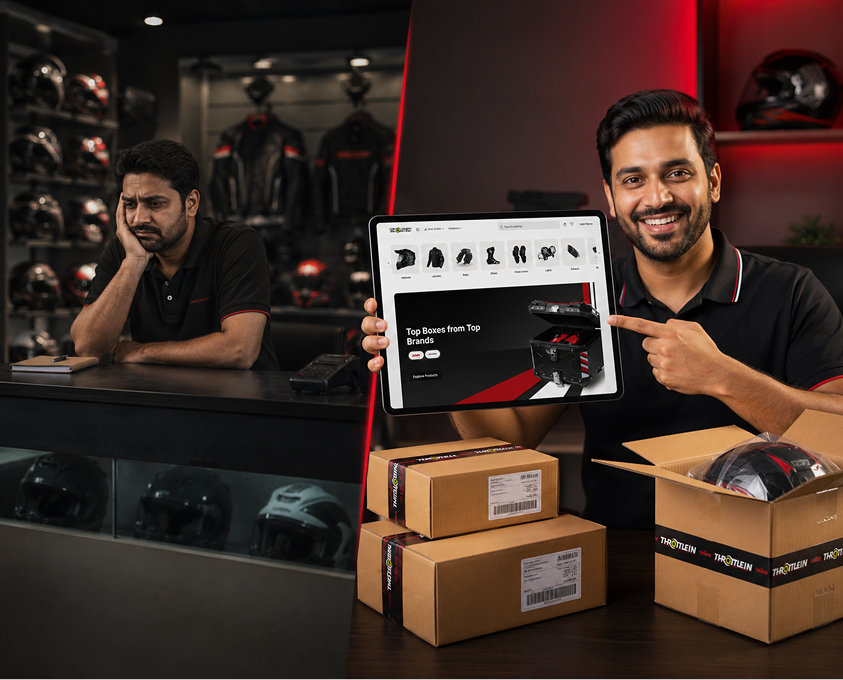
To sell helmets online in India as a two-wheeler dealer, you need a GST registration, a seller account on a platform that reaches your target buyers, certified helmet stock with proper ISI or ECE markings, and product listings detailed enough to replace the in-store fitting conversation. Done right, your showroom's existing inventory and brand trust become your biggest competitive advantages on screen. This guide walks you through every step.
Here is the opportunity in plain numbers: India's two-wheeler helmet market is projected to grow at a CAGR of 6.48% through 2030 (TechSci Research, 2026), and the online segment is currently its fastest-growing distribution channel. Yet offline still holds a 69% market share (IMARC Group, 2025). That gap is closing fast, and the dealers who move their helmet business online now will capture disproportionate revenue from the shift. If you run a two-wheeler showroom, an accessories shop, or a wholesale distribution business, knowing how to sell helmets online in India isn't optional anymore. It's the next phase of your business.
Why Two-Wheeler Dealers Are the Ideal Helmet Sellers Online
Two-wheeler dealers are ideal online helmet sellers because they already hold the three things that take a new seller years to build: certified stock, brand relationships, and customer trust. A Bajaj or Honda dealership that stocks ISI-certified helmets in the showroom already has the compliance and sourcing advantage. Going online is a distribution decision, not a reinvention.
The market context makes this even more compelling. India had over 210 million registered two-wheelers on the road and annual sales exceeding 19.6 million units in FY 2024-25 (SIAM data, via IMARC Group, 2025). Every one of those bikes creates a rider who needs a helmet. From January 2026, the government mandated two BIS-certified helmets with every new two-wheeler sale (MoRTH, 2026), which directly increased volume demand for certified helmets at the retail and wholesale level.
In my experience working with accessory sellers and dealers across India, the showroom advantage is real but perishable. A dealer who doesn't sell online doesn't disappear from the market overnight. But every month offline-only, another seller captures the Tier 2 or Tier 3 customer who would have bought from you if you'd shown up in their search results.
What Do You Need Before You Start Selling Helmets Online?
Before you start selling helmets online, you need four things in place: a valid GSTIN, verified ISI or ECE-certified helmet stock, a clear product photography setup, and a seller account on the platform that reaches your target buyer. All four are achievable within a week if you already run an established dealership.
GST Registration: Your Starting Point
GST registration is mandatory for any dealer selling goods through an Indian e-commerce marketplace, regardless of annual turnover. Marketplaces collect Tax Collected at Source (TCS) on your behalf and cannot activate your account without a valid GSTIN. If you already run a registered dealership, you likely have this. If not, the application is fully digital and typically completes within 3-7 working days (GimBooks, 2026).
Verified, Certified Stock
Every helmet listed for sale on any Indian marketplace must be ISI certified under IS 4151:2015. The BIS conducted over 30 search-and-seizure operations in FY 2024-25, testing more than 500 helmet samples and confiscating over 3,000 non-compliant units (IMARC Group, 2025). The enforcement environment is active. Don't list any helmet you can't verify the BIS licence number for.
For wholesale or bulk sellers, the same rule applies. ISI certification is the minimum for domestic sale. If you're supplying to retailers or other dealers, ECE 22.06 dual-certified stock commands better pricing and builds longer-term buyer relationships.
Documents You'll Need for Seller Registration
GSTIN and GST certificate
PAN card of the business or proprietor
Bank account details for settlement
Business address proof
Brand authorization letter, if you're an authorized dealer for specific brands (required by most marketplaces)
Cancelled cheque or recent bank statement
How Do You Choose the Right Platform to Sell Helmets Online in India?
You choose the right platform by matching your buyer type to the platform's audience. Retail buyers shopping for individual helmets convert best on category-specific platforms with high-intent traffic. Wholesale buyers and bulk orders belong on B2B platforms. General marketplaces sit in between: high reach but high cost and high competition.
Throttlein: The Best Platform for Certified Helmet Dealers
Throttlein is India's dedicated motorcycle accessories marketplace, and it's the strongest platform for helmet dealers who sell ISI and ECE-certified gear to verified riders. Every visitor is already a two-wheeler owner shopping specifically for gear. That means your helmet listing sits in front of buyers who are already in purchase mode, without having to fight for attention against kitchen appliances or phone accessories.
The Throttlein helmets and accessories category is organized specifically for rider shopping behaviour, with full-face, modular, open-face, and adventure helmets each in distinct browsable segments. Your certified stock gets seen by the right buyer without the ad spend required to replicate that on a general platform. Register as a seller on Throttlein and you can be live with your first listings within 48 hours, with the lowest commission in the bike accessory category and zero setup fees for your first 90 days.
General Marketplaces: Amazon and Flipkart
Amazon India reaches 295 million monthly visitors and gives your helmets national reach from day one. The trade-off is cost. Combined platform fees including commission, closing fees, fulfillment, and ad spend regularly run 25-35% of selling price. For helmets in the ₹2,000 to ₹5,000 range, that structure compresses margins significantly unless you're moving high volume.
Flipkart is strong in Tier 2 and Tier 3 cities, which matters for helmets because over 50% of online helmet sales in India occur in Tier 2 and Tier 3 locations (Accio, 2026). If your showroom services a smaller city catchment, Flipkart may reach customers you'd otherwise miss.
IndiaMART and TradeIndia: For Wholesale and B2B
If you're a wholesale distributor or you're selling helmets in bulk to other dealers and shops, IndiaMART is where most of India's B2B helmet sourcing happens. Motorcycle helmet suppliers on IndiaMART list starting from ₹120 per piece for basic models (IndiaMART, June 2026), with B2B buyers comparing bulk pricing, MOQs, certification details, and delivery terms directly. A paid IndiaMART subscription alongside your D2C marketplace presence covers both channels efficiently.
Platform Comparison for Helmet Dealers
Platform | Best For | Audience Type | Commission / Cost | Setup Time |
|---|---|---|---|---|
Throttlein | Certified retail helmets, branded gear | Verified riders, high intent | Lowest in category | 48 hours |
Amazon India | High-volume catalog, national reach | Broad, mixed | 25-35% effective | 3-10 days |
Flipkart | Tier 2/3 reach, mid-range helmets | Price-sensitive, Tier 2/3 | 25-35% effective | 3-10 days |
Meesho | Entry-level helmets under ₹1,500 | Very price-sensitive | 10-15% effective | 1-3 days |
IndiaMART | Wholesale and B2B bulk orders | Dealers, distributors | Subscription-based | Immediate |
How to Write Helmet Listings That Actually Convert Online
A helmet listing that converts answers every question the buyer would ask in your showroom, without you being there to answer it. That means certification proof, compatibility or size guidance, material and ventilation details, and photos that show the helmet from every angle a serious buyer wants to see.
The non-negotiables for every helmet listing:
Title: Brand + helmet type + key certification + standout feature (example: "LS2 FF800 Storm Full Face Helmet, ECE 22.06 + ISI Certified, Anti-Fog Pinlock Visor")
Certification details: State the ISI licence number and BIS mark in the description. For dual-certified helmets, name both ISI and ECE explicitly. This builds buyer trust and protects you from return disputes
Size chart: Include the brand's specific head circumference to size mapping. Fit errors cause returns. Size charts prevent them
Shell material and weight: Polycarbonate, fiberglass composite, or carbon fiber, and the helmet's weight in grams. Riders who've bought gear before care deeply about weight on long rides
Ventilation system: Number and placement of intake and exhaust vents, especially important for Indian summer conditions
Visor details: Anti-scratch, Pinlock-ready, UV-treated, tinted availability
What's in the box: Helmet, visor, Pinlock insert (if included), warranty card, and fitting guide
For wholesale listings on IndiaMART or B2B channels, add minimum order quantity, lead time, packaging specifications, and certification documentation availability.
From auditing helmet listings across platforms, the single biggest gap I see in dealer listings is missing size guidance. Most helmet brands size differently and a buyer who orders a Medium from brand X and gets the wrong size for their head circumference becomes a return, a negative review, and a lost customer. One clear size chart per listing prevents almost all of that.
What Photography Makes Helmets Sell Online?
Helmets sell online when the photos replicate the physical inspection a buyer would do in your showroom. That means multiple angles, interior shots, and context that helps them visualize wearing it.
The minimum photo set for a helmet listing:
Main image: full helmet on a clean dark or white background, filling 85% of the frame, shot slightly from above to show shape
Profile view: pure side shot showing shell depth, visor height, and chin bar length
Front view: straight-on shot showing visor width and any ventilation detailing
Interior shot: liner quality, EPS padding, removable cheek pad construction
Certification shot: ISI mark and BIS number clearly visible on the shell or liner
Lifestyle shot: helmet on an actual rider or mounted on a bike, not just floating on a stand
Visor detail shot: show Pinlock pins, any sun visor if present, and the locking mechanism
Mobile traffic now accounts for over 60% of Indian e-commerce sessions (IMARC Group, 2026). Check every photo on a phone screen before finalizing your listing. A certification shot that's readable on a desktop but blurry on a phone screen is effectively invisible to most of your buyers.
How Do You Handle Returns and Fit Issues When Selling Helmets Online?
Returns and fit issues are the most common challenge when you sell helmets online in India, because fit is personal and impossible to guarantee without physical try-on. The best approach is to reduce return probability through clear size guidance, and to handle the returns you do receive with a pre-defined, consistent process.
How to reduce helmet return rates:
Include a measuring guide in every listing description ("Wrap a tape measure 2.5cm above your eyebrows and note your circumference in cm")
List the head circumference range each size covers, not just the size label
Add a "Which size should I choose?" FAQ section inside your listing description
Offer size exchange as an option before full returns, since many buyers want the right fit rather than a refund
Include a printed size and care guide inside the helmet box so buyers know they received the right product
Helmets certified under IS 4151:2015 cannot legally be resold after return if they've been worn and show any sign of use. Build this cost into your pricing from the start. On Throttlein, the buyer audience is pre-qualified and generally more informed about sizing, which reduces the proportion of fit-related returns compared to general marketplaces.
How to Sell Helmets Wholesale Online in India
To sell helmets wholesale online in India, focus on IndiaMART and TradeIndia for incoming B2B inquiries, and build a separate wholesale seller presence on Throttlein for dealers who are already looking for certified gear to stock in their shops.
Wholesale helmet selling requires different listing content than retail. Buyers need:
Bulk pricing tiers (price per unit at 10, 50, and 100+ piece orders)
Minimum order quantity (MOQ)
Lead time from order to dispatch
Certification documentation (ISI licence number, BIS certificate copy)
Packaging specifications (pieces per carton, carton dimensions and weight)
Payment terms (advance, LC, or credit terms for established buyers)
Return and quality dispute process for bulk orders
The India e-commerce market was valued at USD 129.72 billion in 2025 and is projected to reach USD 651.10 billion by 2034 (IMARC Group, 2025). Wholesale buyers are increasingly sourcing online rather than through physical trade fairs or cold calls to distributors. Your IndiaMART presence is how they find you.
Marketing Your Helmet Business Online Without a Big Ad Budget
Most two-wheeler dealers underestimate how much their existing showroom reputation can do online. You don't need a large ad budget to start. You need consistent listing quality, early review generation, and a presence on the platform where your buyers are already looking.
Low-cost tactics that work for helmet dealers:
Request reviews from showroom customers who also buy from your online listings. Early reviews on any platform compound into long-term ranking and conversion
Share your product listings through WhatsApp groups for local riders and bike clubs. This creates organic initial traffic without any ad spend
Use the rider protection gear category on Throttlein to cross-list complementary products like riding jackets and gloves alongside your helmets. Cross-category selling increases order value without increasing ad spend
Run small initial sponsored ad campaigns of ₹2,000 to ₹3,000 on your top-performing helmet models to establish initial ranking velocity in the first month
Keep your B2B profile on IndiaMART updated with fresh stock availability and new certifications, since buyers filter actively by certification status
Smart helmets with Bluetooth integration are the fastest-growing premium segment in India's helmet market, with the AXOR X Altor Apex Smart Helmet launching in 2025 under ₹7,910 as a signal of where mid-range demand is heading (IMARC Group, 2025). If your stock includes Bluetooth-enabled models, list them alongside Bluetooth accessories on Throttlein for maximum cross-sell relevance.
Conclusion: The Shift Is Happening. Dealers Who Move First Win the Most.
The single most important takeaway from everything in this guide is this: the Indian helmet market is growing and its online channel is growing faster than any other distribution method. The dealers who build their online presence now will compound that advantage over the next five years. Those who wait will pay higher entry costs and fight for shelf space against sellers who've already accumulated reviews, rankings, and repeat customers.
You already have what an online helmet seller spends months acquiring: certified stock, established brand relationships, and a local reputation that translates into early trust signals for buyers. Your showroom is your proof of credibility. Your online listings are just your showroom extended to every pincode in India.
The practical steps are clear. Get your GSTIN confirmed and your top ten helmets photographed with all the angles covered in this guide. Write descriptions that include certification details, size charts, and a clear "what's in the box" statement. Start with Throttlein as your primary channel because the commission is lowest, the onboarding is fastest, and every buyer on the platform is already a rider. Layer in IndiaMART for wholesale inquiries. Add Amazon or Flipkart when you're ready to scale volume.
Visit throttlein.com/sell to start your seller registration today. Your first 90 days include zero setup fees and access to 2M+ verified riders who are already searching for the helmets you carry. The shift from showroom to screen isn't a disruption you need to resist. It's the expansion your business has been ready for.