
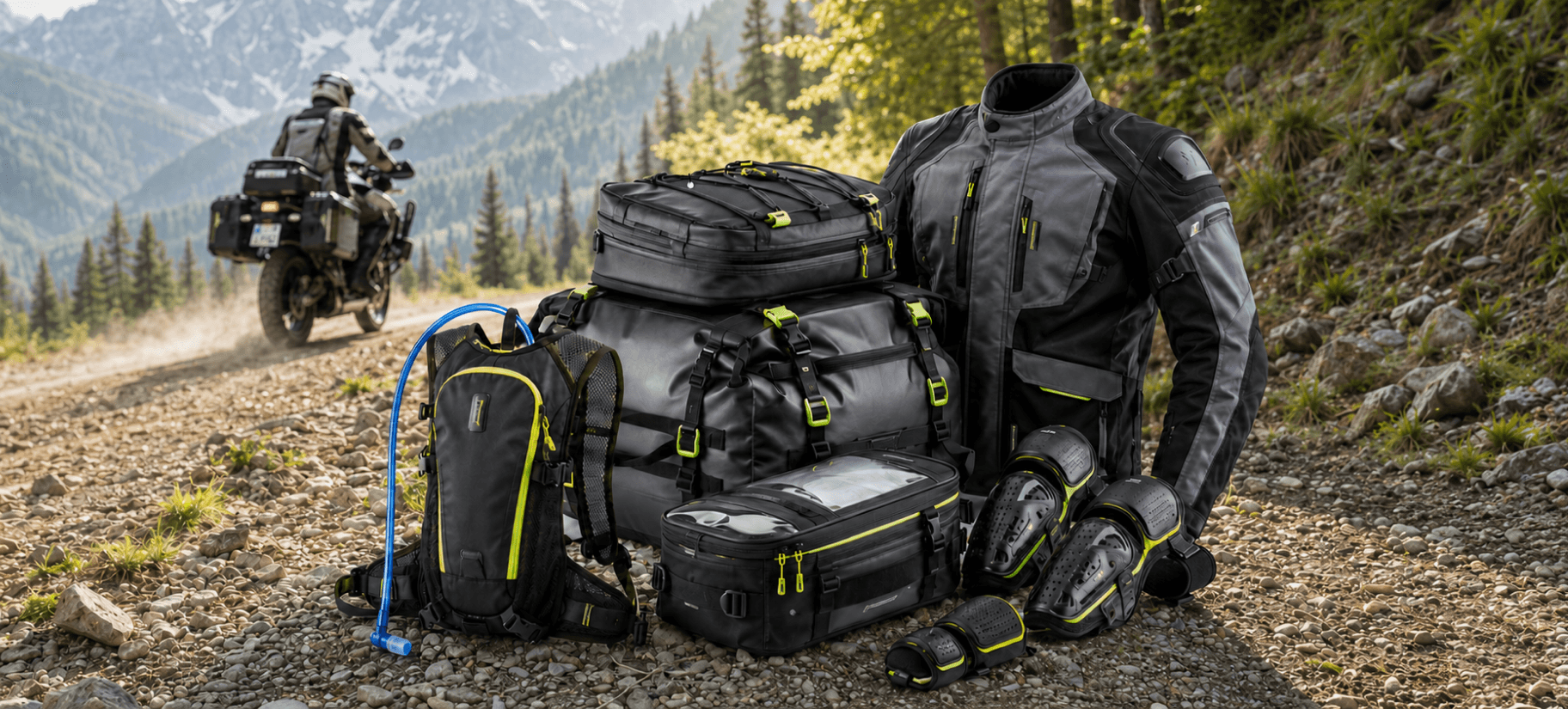
A complete adventure touring packing list covers three non-negotiable pillars: the right luggage system to carry your gear without compromising handling, a serious hydration strategy built for the altitude and dryness of India's mountain routes, and certified riding protection that keeps you safe at remote distances from any hospital. Get any one of these wrong and your Ladakh or Spiti run becomes a very different kind of adventure. Everything you need across all three pillars, from ISI-certified helmets and CE-rated jackets to crash guards, saddlebags, and Bluetooth communicators, is available at Throttlein, India's dedicated motorcycle accessories marketplace, so you can build your complete adventure kit without jumping between platforms.
India's adventure touring scene has grown dramatically. The Manali-Leh highway crosses multiple passes above 4,000 metres, Spiti Valley sits at a base altitude of over 3,000 metres, and the Zojila pass regularly sees temperatures drop below zero even in July. These aren't casual riding conditions. At 3,000 metres, your body loses 50% more water through breathing than at sea level because cold, dry mountain air pulls moisture from your lungs continuously (Outdoor Goats, 2026). At the same altitude, a dehydration level of just 1-2% can cause fatigue, dizziness, and cramping, and all three are genuinely dangerous when you're navigating off-camber turns on a loaded motorcycle above 4,800 metres (Himalayan Hikers, 2026). This guide builds your adventure touring packing list from the ground up: what to carry, how to carry it, and how to stay safe and hydrated across 7-14 days in the most demanding riding terrain India offers.
Why Adventure Touring Demands a Different Packing Philosophy
Adventure touring packing is different from weekend touring packing because the consequences of forgetting something are fundamentally different. Leave behind your rain cover on a weekend ride to Coorg and you get wet. Leave it behind on the Manali-Leh highway and you're soaked on a mountain pass with the nearest gear shop 200 kilometres away.
The core principle of smart adventure touring packing is this: plan for the environment you'll be in, not for the nearest town. Your packing list should assume there are no shops, no mechanics, no pharmacies, and no phone signal for stretches of 100-200 kilometres at a time. That's not pessimism. It's preparation.
Packing smart also means understanding weight distribution. Every kilogram you add to your bike affects handling, especially on the unpaved, loose-gravel stretches that appear regularly on adventure routes. The general principle is to keep heavier items low and close to the bike's centreline, distribute weight evenly between left and right saddlebags, and never load more on the rear than the bike's specifications allow. Most 350-400cc adventure bikes have a maximum load capacity of 15-20 kg including pillion, bags, and accessories. Plan accordingly.
The Luggage System: Building Capacity Without Killing Handling
Your luggage system is the foundation of your adventure touring packing list. Get the capacity and mounting right first, then fill it intelligently. A well-designed adventure luggage setup typically combines a tail bag or soft panniers for primary capacity, a tank bag for frequently accessed items, a handlebar bag for small essentials, and dry bags inside each piece for waterproofing.
Saddlebags and Panniers: Your Primary Load Carriers
Saddlebags or soft panniers provide 40-80 litres of combined capacity for a full adventure tour and are the workhorse of any motorcycle luggage system. For Indian adventure riding, waterproofing is non-negotiable. The Rohtang Pass, Baralacha La, and most Himalayan route segments receive unpredictable rain and snow even in summer months. A dry bag with roll-top closure, not just a zip, is the minimum weatherproofing standard for adventure use.
What to check before buying saddlebags:
Subframe or rack compatibility for your specific bike model. Confirm mounting hardware fits your Royal Enfield Himalayan, KTM Adventure, Hero Xpulse, or Bajaj Dominar's subframe type
Roll-top or welded seam waterproofing rather than zip with rain cover for sustained monsoon and mountain weather exposure
Total combined capacity of at least 40 litres for a 7-day trip, 60 litres for 10-14 days
Rigid inserts or frame structure to prevent bags from sagging into the wheel
Browse the full range of adventure saddlebags and touring luggage on Throttlein with model-specific compatibility listed for popular Indian adventure bikes.
Tank Bags: Your Mission Control for Daily Ride
A tank bag is the most-accessed piece of luggage on any adventure tour. It sits in your direct sightline, opens and closes without stopping, and is the natural home for your phone, snacks, sun protection, documents, and a small first aid kit.
Key features to look for in an adventure tank bag:
Magnetic mount or adjustable strap mount with a quick-release buckle for fast on and off at petrol stations and checkpoints
A clear map or phone pocket on the top panel, large enough for your phone's screen to be readable through it
Capacity between 5 and 15 litres, depending on whether you're using it as your primary daily-access bag or as an overflow complement to your panniers
Waterproof or water-resistant outer material, since the tank bag is fully exposed on every rainy pass
Tail Bag: Overflow Capacity and Sleeping Gear
A tail bag strapped to the pillion seat or rear rack adds 20-35 litres of overflow capacity that takes the pressure off your saddlebags. On multi-day adventure tours where you're carrying a sleeping bag, camp mat, or extra clothing layers, a tail bag is often the difference between fitting everything in and leaving something behind.
Load your tail bag with softer, lower-density items: sleeping bag, insulation layers, and rain gear. Keep heavier items like tools and spare parts low in your saddlebags.
Handlebar and Frame Bags: Smart Storage for Small Essentials
Handlebar bags and small frame-mounted bags are increasingly popular on Indian adventure bikes for storing quick-access items without opening the main luggage. A handlebar bag holding a 0.5-1 litre water bottle, your wallet, and your route notes saves time at every stop and keeps the most-used items within arm's reach without needing to pull over.
The Hydration Strategy: The Most Underestimated Risk on Indian Adventure Routes
Hydration is the most underestimated risk in Indian adventure touring, specifically on Himalayan routes above 3,000 metres. At altitude, your thirst mechanism becomes unreliable. You can be significantly dehydrated before feeling thirsty, which is the opposite of how the body works at sea level (Himalayan Hikers, 2026). The dry wind on high-altitude mountain passes evaporates sweat instantly, giving you no sensory feedback about how much fluid you're losing.
The mandatory hydration target for riding at altitude in Ladakh or Spiti is 4-5 litres of fluid per day, including electrolytes to prevent muscle cramping (Himalayan Rides, 2026). Plain water is not sufficient because you lose sodium and potassium through sweat and respiration. Muscle cramping on a heavily loaded motorcycle on a mountain pass is not just uncomfortable. It's genuinely dangerous.
Hydration Pack vs Bottle: What Works on a Bike
The challenge with staying hydrated on a motorcycle is that stopping every 20 minutes to drink is not always practical on mountain routes where safe stopping points are limited. A hydration backpack with a 2-3 litre reservoir and a drinking tube solves this problem. You can sip continuously while riding without stopping or removing your helmet.
For riders who prefer not to wear a backpack, a large insulated bottle in your handlebar bag or tank bag with a conscious discipline to stop and drink at every fuel stop is a workable alternative. Whatever system you choose, carry a minimum of 3 litres of accessible water at any point during the day on any route that crosses passes above 4,000 metres.
Electrolytes: Pack More Than You Think You Need
ORS sachets, electrolyte tablets, or sports drink powder should be packed in enough quantity for every day of your trip plus two additional days as a buffer. At altitude, symptoms of dehydration and early altitude sickness (AMS) are almost identical, and dehydration makes AMS significantly worse (Travel Coffee, 2026). Staying electrolyte-replenished is one of the most effective preventive measures for AMS available to a motorcycle rider.
Pack ORS sachets in your tank bag's front pocket so they're accessible without stopping. A minimum of two sachets per day plus four emergency sachets is the right quantity for a 7-10 day Himalayan route.
Water Purification: Don't Depend on Bottled Water Availability
Remote Himalayan stretches regularly have no shops for 100-150 kilometres. Carrying 5 litres of bottled water is impractical on a motorcycle. A water purification solution: SteriPen UV purifier, iodine tablets, or a Sawyer filter squeeze, is the smart adventure touring solution. This lets you refill from streams and villages without depending on plastic bottle availability.
The Protection Kit: Gear Built for Remote Riding
Adventure touring protection requirements exceed standard commuter or weekend touring gear for two reasons: you're riding at higher speeds on challenging terrain far from medical facilities, and you face a much wider range of environmental conditions including altitude cold, monsoon rain, dry desert heat, and everything in between on the same trip.
The Adventure Helmet: ECE 22.06 Plus Dual-Sport Design
An adventure tour in India demands an ECE 22.06 certified helmet, not just ISI. The rotational impact testing in ECE 22.06 addresses the category of brain injury that standard ISI testing does not cover, and at the speeds and terrain of Indian adventure routes, that difference is meaningful.
For Himalayan and mixed-terrain riding, a dual-sport adventure helmet with an extended chin bar and peak visor is the most practical choice. It handles highway sections at 80-100 km/h and loose gravel off-road segments with equal reliability. On pure tarmac adventure routes like Leh-Kargil or the Kerala coast circuit, a full-face ECE 22.06 certified touring helmet with strong wind noise management and a Pinlock-ready visor is the right call.
Key adventure helmet features to prioritize:
ISI plus ECE 22.06 dual certification
Shell weight under 1,400 grams to reduce neck fatigue over 8-10 hour riding days
Pinlock-ready visor or supplied Pinlock insert for cold-morning fogging
Emergency release system for the cheek pads if paramedics need access
Browse ISI and ECE 22.06 certified adventure helmets at Throttlein's helmets and accessories section, where full-face and dual-sport options are organized separately so you find the right type without scrolling through commuter helmets.
The Adventure Jacket: All-Weather Is Non-Negotiable
On an adventure tour across India's Himalayan routes, you will ride in heat, rain, and cold, often on the same day. A single-weather jacket is the wrong choice. An all-season textile jacket with a removable waterproof membrane and a detachable thermal liner is the correct adventure touring solution.
What your adventure jacket must have:
CE Level 2 certified back protector (not just a back protector slot with a foam insert)
CE Level 1 or Level 2 shoulder and elbow armor
Waterproof membrane that covers the full jacket body and sleeves, not just the outer shell
Ventilation panels that open and close with zippers for temperature regulation
High-visibility reflective panels for tunnel sections and post-sunset riding
Tall collar that seals against the helmet chin bar to prevent cold wind entry at altitude
For Himalayan altitude riding, jacket insulation layers matter. Temperatures above 4,000 metres can drop to 5-10°C even in July during a weather event, and at those temperatures on a moving motorcycle, wind chill makes the felt temperature significantly colder.
Check adventure-ready riding jackets on Throttlein for all-season textile options with detachable liners built for Indian touring conditions.
Riding Pants and Lower Body Protection
Most adventure riders protect their upper body carefully and neglect their lower body entirely. This is a significant protection gap. In a slide, your knees, hips, and shins impact the road before almost anything else. CE-certified riding pants with armor slots for knee, hip, and shin protection are the right investment for any ride that crosses remote terrain.
If riding pants don't suit your trip's non-riding activities, CE Level 1 knee guards that strap over regular trousers are a practical minimum. Find certified options in the rider protection section on Throttlein, where knee guards, back protectors, and body armor are organized separately.
Adventure Riding Gloves: Heated or Insulated for High Altitude
Standard riding gloves are insufficient for riding above 4,000 metres at dawn or after dark. At Khardung La (5,359 metres) or Baralacha La (4,890 metres), temperatures regularly drop below zero and bare-finger exposure under standard mesh gloves causes numbness within minutes. Numbness in the hands is a direct handling hazard on a loaded adventure bike.
Pack two pairs of gloves for any Himalayan route: summer mesh gloves for warm midday sections and insulated or windproof touring gauntlets for early starts, high passes, and any section above 4,000 metres. Both types with CE knuckle protection are available in the rider protection section on Throttlein.
Crash Guards: The Most Cost-Effective Adventure Bike Investment
For adventure touring, crash guards are not optional. Remote unpaved sections, loose gravel, and stream crossings make low-speed falls a routine occurrence on Indian adventure routes, not an edge case. A quality crash guard set costing ₹3,000 to ₹8,000 prevents ₹15,000 to ₹40,000 worth of engine casing, panel, and footpeg damage from a fall that would otherwise be entirely minor.
Confirm model-year compatibility for your specific bike before purchasing. Browse bike crash guards and protection accessories on Throttlein with compatibility listed for Royal Enfield Himalayan, KTM Adventure, Hero Xpulse, Bajaj Dominar, Honda CB, and Yamaha MT series bikes.
The Electronics and Navigation Kit
Auxiliary Lighting: Not Optional for Mountain Riding
Mountain passes and tunnels on Indian adventure routes are genuinely dangerous without auxiliary lighting. The Rohtang Tunnel, the Zojila sections, and multiple high-altitude stretches have limited visibility even in daylight due to dust, snow glare, and shadows. After dark, unlit sections with cattle and debris make standard headlights significantly insufficient.
LED auxiliary lights rated at a minimum 30W per lamp with IP67 water resistance for all-weather use are the right specification for adventure touring. A relay switch setup ensures the lights don't overload your bike's electrical system. Check available auxiliary lighting options on Throttlein for units compatible with 12V adventure bike electrical systems.
Bluetooth Communicator: Safety for Solo and Group Adventure Riders
On group adventure tours, a Bluetooth communicator is an active safety tool, not just a convenience. It allows immediate group communication when the lead rider spots a hazard, coordinates regrouping after separated sections, and provides navigation audio without phone handling.
For solo adventure riders, a Bluetooth unit streaming navigation audio keeps attention on the road rather than on a phone screen at handlebar level. This matters especially on technical terrain where both hands and full attention belong on the bike, not on managing navigation.
Multi-rider mesh intercom systems with ranges of 1-1.6 km between riders and group sizes up to eight are available for group touring. Single-unit communicators for solo riders are a more affordable entry point. Explore adventure-compatible Bluetooth communicators on Throttlein.
Phone Mount and Navigation Setup
Your phone is your primary navigation tool on Indian adventure routes where dedicated GPS units remain rare. A vibration-dampening phone mount with both a grip-arm clamp and a secondary safety tether is the minimum specification for adventure use. Standard grip-arm mounts without a tether can work loose on seriously rough terrain. A ₹50,000 phone bouncing onto an unpaved mountain road is not how you want a day to end.
Check handlebar phone mounts on Throttlein for vibration-dampened adventure-rated options compatible with your bike's handlebar diameter.
The Tool Kit and Spares: Self-Sufficiency Between Fuel Stops
An adventure touring packing list without a tool kit is incomplete. On Himalayan routes, the nearest motorcycle mechanic can be 150-200 kilometres away. Self-sufficient riders carry at minimum:
Essential tool and spares kit:
Puncture repair kit (tubeless plug kit plus a portable inflator)
Spare inner tube if your bike runs tubed tyres
Basic spanner and socket set in the sizes your bike's bolts use
Zip ties, duct tape, and baling wire (solves an astonishing range of field problems)
Clutch and brake levers (the most commonly snapped parts in a light fall)
Chain lube and a chain tool if your bike runs a chain drive
Spare fuses in the sizes your bike uses
Spare engine oil (200-300 ml minimum for a 7-day trip)
Tyre pressure gauge
Keep the tool kit in a small, dedicated roll or hard pouch that stays in the same saddlebag every day so it's always in the same place when you need it fast.
The Complete Adventure Touring Packing List
Use this as your pre-departure checklist. Tick each category before you load the bike.
Riding Protection:
ISI plus ECE 22.06 certified full-face or dual-sport adventure helmet
All-season textile jacket with CE Level 2 back protector and waterproof membrane
CE-certified riding pants or knee guards and hip protection
Touring gauntlet gloves plus mesh gloves for warmer sections
Ankle-protecting riding boots
Luggage System:
Waterproof saddlebags or soft panniers (40-60 litres combined minimum)
Tank bag with clear phone/map window (5-15 litres)
Tail bag for overflow and sleeping gear (20-35 litres)
Handlebar bag for daily essentials
Dry bags inside saddlebags for absolute waterproofing of electronics and documents
Bike Protection and Accessories:
Crash guards for engine and frame protection
LED auxiliary lights with IP67 rating and relay switch
Vibration-dampened phone mount with safety tether
Hydration:
3-litre hydration backpack with drinking tube or equivalent large-capacity bottle accessible while riding
ORS/electrolyte sachets (minimum 2 per day plus 4 emergency sachets)
Water purification tablets or SteriPen UV purifier
Insulated water bottle (0.5 litre) for hot drinks at altitude
Navigation and Electronics:
Bluetooth communicator (single or multi-rider)
Offline maps downloaded on phone (Google Maps, Maps.me, or OsmAnd for remote segments)
20,000 mAh minimum power bank
USB charging cable with bike-mounted USB outlet or 12V adapter
Tool Kit and Spares:
Puncture repair kit
Spare inner tube (if applicable)
Basic spanner and socket set
Zip ties, duct tape, baling wire
Spare clutch and brake levers
Chain lube and tool
Spare fuses and 200 ml engine oil
Documents and Essentials:
Driving licence, registration certificate, insurance documents
Route permits (Nubra Valley, Pangong, Tso Moriri require inner line permits)
Emergency contact list written on paper, not only in phone
First aid kit with altitude sickness medication (Diamox, prescribed by a doctor)
Sunscreen SPF 50 or higher (UV radiation is significantly higher above 3,000 metres)
Lip balm and moisture cream (mountain dry air causes cracking within 48 hours)
Weight and Packing Strategy: Keep the Bike Handling
A fully loaded adventure touring bike with luggage, gear, and a rider typically carries 20-30 kg over its standard riding weight. Weight distribution is as important as total weight.
Rules for loading your adventure bike:
Heaviest items go in the bottom of the saddlebags, as low and central as possible
Left and right saddlebags should be balanced within 500 grams of each other
The tail bag takes soft, light items only (sleeping bag, insulation, rain gear)
Nothing goes on the tank bag that takes it above your comfortable riding position
Electronics and documents go in waterproof inner bags even if your luggage claims to be waterproof
Fuel load affects weight distribution significantly on routes with long fuel gaps; plan fill-ups to maintain balance
On routes like Manali to Leh (480 km with limited fuel stops), carrying a 5-litre fuel can on the rear subframe is recommended. Check your bike's subframe load rating before strapping anything there.
Conclusion: Prepare for the Environment, Not the Nearest Town
The single most important mindset for adventure touring packing is this: every decision on your packing list should assume the nearest town is 200 kilometres away. That assumption drives the right choices across luggage, hydration, and protection every time.
Pack waterproof luggage because Indian mountain passes receive rain without warning at any time of year. Carry 4-5 litres of daily fluid including electrolytes because altitude dehydration is silent and dangerous. Wear ECE 22.06 certified protection with a CE Level 2 back protector because adventure routes involve higher-energy falls at greater distances from medical help than any weekend ride.
India's adventure riding routes, from Ladakh and Spiti to the Northeast and the Western Ghats, offer riding experiences that rank among the best in the world. The preparation gap between a trip that goes smoothly and one that doesn't is almost always the difference between riders who packed for the environment and riders who packed for the best-case scenario.
Build your adventure touring packing list from Throttlein, where every seller is verified and every category is built for the two-wheeler community. Start with your ECE-certified helmet, add your all-season jacket and rider protection, mount your crash guards, fit your auxiliary lights and Bluetooth communicator, and load up your verified adventure luggage system. Then go ride something worth packing for.