
Motorcycle auxiliary lights are supplementary lighting systems mounted alongside your main headlight to improve visibility in low-light, foggy, rainy, or unlit road conditions. If you're riding Indian highways after dark, navigating monsoon roads, or doing any kind of adventure touring, your standard headlight is not enough. The right auxiliary light setup can be the difference between spotting a pothole at 80 km/h and hitting it. Browse verified auxiliary lighting options on Throttlein, where every product is sourced from verified sellers for Indian road conditions.
Here's the number that should make this personal: over 44% of all road fatalities in India involve two-wheeler riders (MoRTH, 2025), and a significant proportion of fatal two-wheeler accidents occur on unlit rural and semi-urban roads between dusk and dawn. LED headlights produce 3,000 to 6,000 lumens compared to 700 to 1,200 lumens from a standard halogen headlight (Bikeleague.in, 2026). Auxiliary lights extend your beam width, fill in the shadows your single headlight creates on curves, and make your motorcycle significantly more visible from the front to oncoming traffic. This guide explains the difference between fog lights and LED auxiliary lights, when each type works best, what specs to check before buying, and what India's motor vehicle rules actually permit.
What Are Motorcycle Auxiliary Lights and Why Do You Need Them?
Motorcycle auxiliary lights are secondary lighting units mounted beside or below the main headlight to extend your effective visual range, widen the beam footprint, and improve your bike's visibility to other road users. They exist because a single headlight, even a powerful LED unit, creates narrow cone coverage that leaves the road edges and near-field areas in shadow.
Auxiliary lights are worth having because a single headlight on a motorcycle produces a narrower beam than a car's two-headlight setup, which means less road edge illumination on curves, less depth of field in varying terrain, and lower visibility to oncoming drivers who may not register a single point of light as a motorcycle until it's very close.
On Indian roads specifically, the case is stronger than in most countries. Unlit highway stretches, cattle on rural roads, trucks parked without hazard lights on ghat bends, and monsoon-reduced visibility all compound the single-headlight limitation. Riders who've added a quality auxiliary light pair consistently report that the improvement in near-field and edge illumination is immediately noticeable, especially on ghat roads and tree-lined state highways.
What Is the Difference Between Fog Lights and LED Auxiliary Lights?
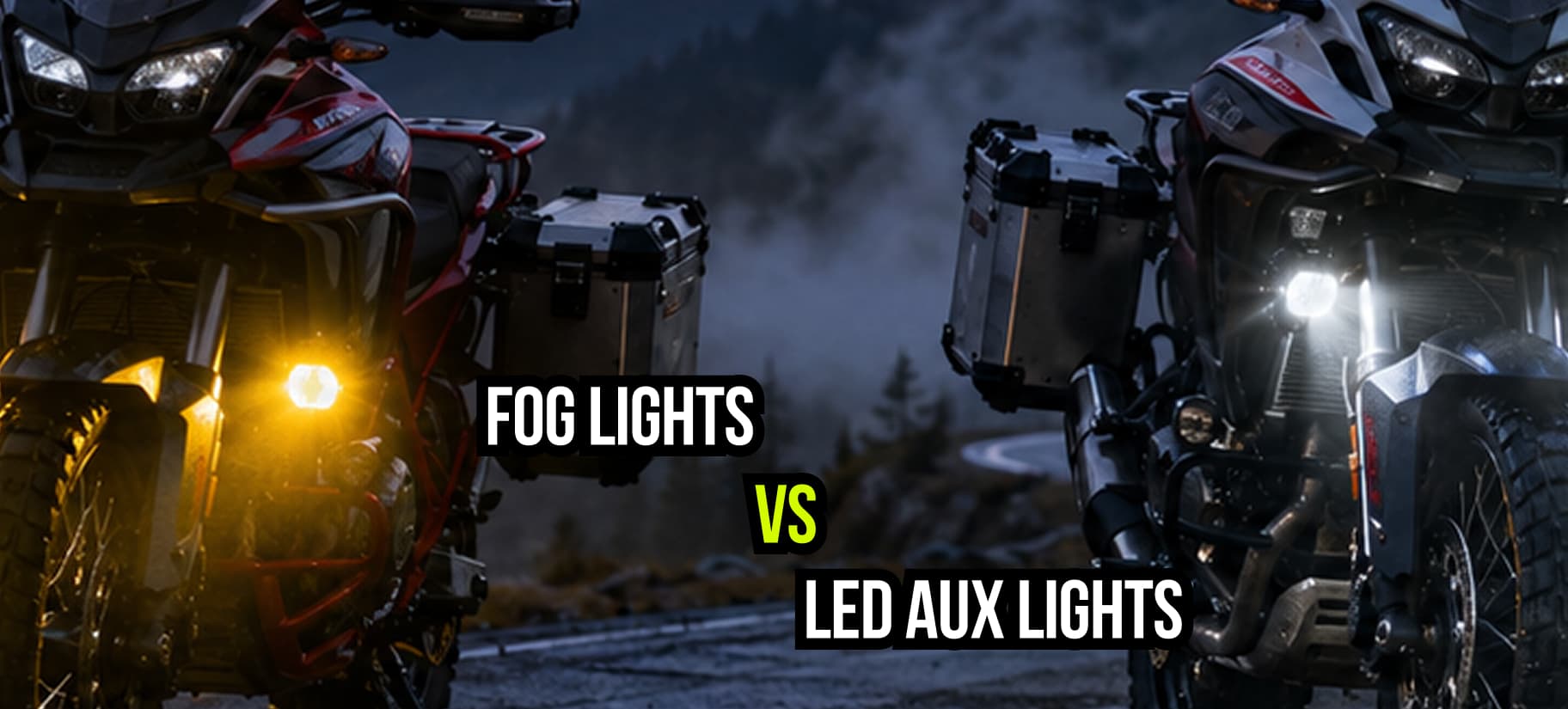
Fog lights and LED auxiliary lights serve overlapping but distinct purposes, and choosing the wrong type for your riding conditions leaves protection gaps even after you've spent the money.
Fog lights throw a wide, flat, low-mounted beam designed to illuminate the road surface close to the bike without the vertical height that causes backscatter in foggy, rainy, or dusty conditions. The flat beam pattern cuts through visual interference by keeping the light below the level where fog, rain, and dust particles reflect it back. Fog lights are most effective in conditions where visibility is already reduced.
LED auxiliary driving lights throw a focused or combo beam designed for distance illumination at highway speeds. They're mounted higher and angled forward, filling in the area beyond your headlight's throw range. These are most effective on clear-sky night riding on highways and rural roads.
Spot lights are a sub-category of driving lights that throw an extremely narrow, concentrated beam for maximum long-range illumination. They're ideal on open highways but create sharp shadows at road edges and are unsuitable as the only auxiliary option in populated areas.
The definitional rule is this: fog lights solve near-field visibility in bad weather; LED driving lights solve long-range visibility in clear conditions; a combo beam does both reasonably well at a single price point. Most Indian touring riders are best served by a combo beam auxiliary setup that handles both highway running and monsoon riding without needing to swap lights between seasons.
Fog Lights for Motorcycles: When Do They Actually Help?
Fog lights for motorcycles help when visibility is reduced by fog, rain, dust, or smoke, and when riding at speeds below 60 km/h where the near-field beam coverage is more critical than long-range illumination. They're the right choice for monsoon commuters, riders navigating ghat roads in morning mist, and anyone who regularly crosses the North Indian plains during winter fog season.
How Fog Light Beam Patterns Work
Fog lights use a wide horizontal cut-off beam, typically a 120-degree or wider spread, mounted 20-40 cm below the standard headlight height. The low mounting position is deliberate. By keeping the light source close to the road plane, the beam travels along the surface rather than projecting into the fog layer above, which is where backscatter occurs.
Yellow light at around 3,000K color temperature penetrates fog more effectively than white light at 6,000K because shorter wavelengths scatter more in moisture-laden air (Bikeleague.in, 2026). This is why traditional fog lights used yellow bulbs, and why modern dual-color LED fog lights that switch between white and yellow modes are popular with Indian touring riders who face both clear-night highway riding and morning mountain mist.
Who Should Prioritize Fog Lights
Fog lights are the better primary auxiliary choice for:
Daily commuters in North Indian cities during October to February fog season
Riders who frequently take ghat roads in monsoon and early morning conditions
Adventure tourers riding Himalayan routes above 3,000 metres where morning valley fog is routine
Riders in coastal areas where humidity and light rain are frequent year-round
For pure highway night riding on clear roads, a dedicated LED driving light with a longer throw outperforms a fog light. The practical solution for most Indian riders is a combo beam unit or a dual-mode light that handles both scenarios.
LED Auxiliary Lights for Motorcycles: What Makes Them Different?
LED auxiliary lights for motorcycles are dedicated high-lumen units that use Light Emitting Diode technology to produce brighter, more energy-efficient, and longer-lasting illumination than halogen equivalents. A quality LED auxiliary pair in the 30W to 60W per-unit range produces 3,000 to 6,000 lumens per pair, extending effective night vision range from the typical 40-50 metres of a stock headlight to 100-150 metres and beyond.
LED vs Halogen Auxiliary Lights: The Key Differences
Feature | LED Auxiliary | Halogen Auxiliary |
Lumen output | 3,000 to 6,000 per pair (30-60W) | 1,400 to 2,800 per pair |
Power consumption | 30-60W total | 55-110W total |
Heat generation | Low (heat sinks manage thermal load) | High (burns hot, fades faster) |
Lifespan | 25,000 to 50,000 hours | 500 to 1,000 hours |
Color temperature | 5,500K to 6,500K (white) or dual-color | 3,000K to 4,000K (warm yellow-white) |
IP water resistance | IP67 to IP68 available | IP54 to IP65 typical |
Price (India) | ₹2,500 to ₹12,000 per pair | ₹800 to ₹3,500 per pair |
Monsoon durability | Higher (sealed LED modules) | Lower (filament sensitivity to vibration) |
For Indian conditions, LED auxiliary lights are worth the higher initial price because the monsoon factor makes IP67 water resistance a practical necessity, and the lifespan difference means you're not replacing bulbs after every touring season.
Beam Patterns in LED Auxiliary Lights
LED auxiliary lights come in three beam configurations:
Spot beam: Narrow, long-throw beam for highway use. Maximum range but sharp shadows at road edges. Best for open highway night riding, not for urban or ghat sections
Flood beam: Wide-angle, lower throw beam. Better near-field coverage, good for rough terrain and slow-speed navigation. Limited distance performance
Combo beam: Combines a central spot with outer flood coverage. The most practical choice for Indian touring riders who need both highway range and monsoon near-field coverage in one light
Most of the best-performing auxiliary lights for Indian conditions use a combo beam pattern because it handles the widest range of real riding scenarios without requiring you to carry or swap between light types.
How to Choose the Right Auxiliary Light for Your Riding Style
The right auxiliary light for your bike depends on four factors: your primary riding conditions, your bike's electrical capacity, the mounting position available on your bike, and the legal compliance requirements you need to meet.
Matching Light Type to Riding Conditions
Daily city commuter: A pair of compact LED fog lights in the 15-20W per-unit range, mounted below the headlight with a wide-angle flat beam, is the right starting point. You don't need long-range illumination in city traffic. What you need is better road-edge coverage for potholes, better visibility to other drivers, and fog penetration for winter commutes. Look for units under 15 cm in diameter that mount on existing crashbar brackets or universal clamps without permanent modification.
Highway tourer: A combo-beam LED auxiliary pair in the 25-35W per-unit range, mounted at or just below headlight height and aimed 3-5 degrees downward, gives you both highway range extension and enough flood coverage to handle rain and fog. Look for IP67 or IP68 rated units. At highway speeds in monsoon rain, anything below IP67 risks water ingress into the LED module within a season.
Adventure and off-road tourer: Spot or combo-beam units in the 30-60W per-unit range with reinforced mounting brackets designed for vibration. Off-road riding generates significantly more chassis vibration than highway riding, and light units with poor mounting hardware loosen or develop connector failures within a few thousand kilometres on Indian forest and mountain trails. Crash bar mounting is preferred over handlebar or fork mounting for adventure bikes, because crash bars absorb tip-over impact without transmitting it to the light housing.
Ghat and mountain rider: Wide flood or combo-beam units at low mounting height. On ghat roads, the main hazard is the sharp-edged near-field shadows your headlight creates on tight hairpin bends. A wide-beam auxiliary pair eliminates those shadows by filling in the low-angle light on the inside of corners. Fog capability is a bonus for morning starts above 2,000 metres.
What Specs Should You Check Before Buying Motorcycle Auxiliary Lights?
Before buying any auxiliary light set for your motorcycle, check these six specifications in the product listing. Every one of them directly affects how well the light works in Indian conditions.
1. IP (Ingress Protection) Rating IP67 is the minimum for Indian year-round riding. IP67 means the unit is fully dust-sealed and can withstand immersion in 1 metre of water for 30 minutes, which covers full monsoon riding. IP68 is better for adventure riders who cross streams and ride in heavy sustained rain. Anything below IP65 risks failure in the first heavy downpour.
2. Wattage and Lumen Output More watts does not always mean more usable light. Lumen output and beam pattern efficiency determine real-world performance. For motorcycle use, 20-35W per unit with an efficient reflector typically outperforms a poorly designed 50W unit. Check both the watt rating and the claimed lumen output together.
3. Color Temperature 6,000K produces pure white light ideal for clear-night highway riding. 3,000K produces yellow light that penetrates fog and rain better. Dual-color units that switch between both modes are worth the slightly higher price if you ride in both conditions.
4. Mounting Compatibility Check whether the mounting bracket fits your bike's existing crash bar diameter, handlebar diameter, or fork tube size. Universal clamp sizes typically cover 20-32mm diameters. For adventure bikes, confirm whether crash bar mounting hardware is included or needs to be purchased separately.
5. Wiring Harness Quality A quality auxiliary light pair includes a relay-switched wiring harness that draws power directly from the battery rather than from the headlight circuit. This is important because tapping directly into your bike's existing headlight loom can overload the factory wiring on bikes not designed for additional lighting loads. A relay harness with an independent fuse protects your bike's electrical system and provides a cleaner switching operation.
6. Beam Aim Adjustability Look for horizontal and vertical aim adjustment in the bracket design. Even a 5-degree difference in vertical aim dramatically changes where the light falls at 50 metres. Correctly aimed auxiliary lights illuminate the road ahead. Incorrectly aimed ones blind oncoming traffic and earn you a confrontation on the highway.
You can browse auxiliary lighting options with full specification details at Throttlein's lighting section, where product listings include wattage, IP rating, beam pattern, and mounting hardware details for each unit.
Are Auxiliary Lights Legal in India? What the Rules Actually Say
This is the section most auxiliary light guides skip, and it's the one that gets Indian riders into trouble with traffic police.
India's Central Motor Vehicle Rules (CMVR) and RTO regulations set specific requirements for vehicle lighting that apply to auxiliary and fog lights:
The key legal rules in India:
A motorcycle is permitted a maximum of four lights total, including the main headlight and any auxiliary or fog lights (RTO Rules, 2026)
Headlights and auxiliary lights must not exceed 1.5 metres in height from the ground
Only white or yellowish lights are permitted. Blue lights are completely prohibited (RTO Rules, 2026)
Light intensity must be controlled so it does not blind a person from 8 metres away
High beams must be switched off when approaching oncoming traffic
Penalties for non-compliance: First-time violations involving improper or non-compliant lighting carry a challan of ₹500. Repeat violations cost ₹1,500 (Acko, 2026).
The grey zone: ARAI approval Ride N Repair's 2026 legal guide notes that adding LED light bars or auxiliary lights not approved by the Automotive Research Association of India (ARAI) is technically illegal (Ride N Repair, 2026). In practice, enforcement varies significantly by state and city. Major metro traffic police in Delhi and Mumbai enforce more actively than rural state highways.
The practical compliance approach:
Mount auxiliary lights below 1.5 metres from the ground
Use only white or yellow beam colors
Ensure the beam is properly aimed so it doesn't blind oncoming traffic at 8 metres
Do not wire auxiliary lights to operate simultaneously with your high beam in urban areas
Keep your total front lights within the four-light maximum
Riders who use auxiliary lights responsibly, aim them correctly, and switch them off in urban traffic rarely face enforcement issues. The lights that get riders into trouble are extremely high-intensity units aimed at oncoming traffic levels and blue or colored lights that resemble emergency vehicle lighting.
Installation Basics: What You Need to Mount Auxiliary Lights Correctly
You don't need a mechanic to install a quality auxiliary light pair on your motorcycle. Most complete kits include everything needed for a straightforward installation. Here's what the process involves:
What a complete auxiliary light kit should include:
Two light units with brackets
Relay wiring harness with fuse
ON/OFF switch (handlebar or dashboard mount)
Mounting hardware (nuts, bolts, cable ties, zip clips)
Wiring diagram
The installation sequence:
Mount the brackets on your crash bar, fork legs, or handlebar using the supplied clamps. Do not overtighten on thin-walled aluminium components
Route the wiring harness from the lights along the existing cable channels to the battery, using zip ties to secure against vibration and abrasion
Connect the relay harness to your battery terminals (positive to positive, negative to negative) and install the in-line fuse
Connect the switch lead to your handlebar switch housing or a spare switched 12V feed from your accessories circuit
Aim the lights before final tightening. Sit on the bike, look at where each beam falls on a wall at 5 metres, and adjust up or down by loosening the bracket bolt and repositioning
Test the circuit through a full ride cycle including a rain wash test to confirm all connector seals are sound before your first night ride
If your bike has a thin factory wiring loom or limited battery capacity (many 125cc and 150cc commuters), choose a lower wattage pair in the 15-20W per-unit range to avoid stressing the charging circuit. For bikes above 200cc with alternators rated at 250W or more, a 25-35W per-unit pair runs comfortably without affecting other electrical systems.
Pair your auxiliary light setup with a phone mount and navigation system from Throttlein so your lit-up night riding setup includes both road visibility and confident route navigation.
What Other Gear Should You Pair With Your Auxiliary Lights?
Auxiliary lights improve what you can see. The rest of your safety setup determines what happens when something unexpected appears in that improved beam coverage.
For night riding and long-distance touring, a complete visibility and safety kit includes:
Full-face ISI or ECE-certified helmet for maximum protection at highway speeds. Browse verified options at Throttlein's helmet section
Reflective riding jacket so you're as visible from behind as your auxiliary lights make you from the front. Check riding jackets on Throttlein for options with reflective strips
Crash guards to protect your bike's engine and frame if a low-speed night incident occurs. Browse bike protection on Throttlein
Bluetooth communicator for navigation audio and group riding communication after dark. Check Bluetooth accessories on Throttlein
Touring luggage with reflective elements or a mounted tail light for improved rear visibility on unlit roads. Browse bags and backpacks on Throttlein
Night riding done properly is about a layered visibility system where you can see farther, be seen more easily, and have the gear to handle what happens if something goes wrong. Auxiliary lights are one essential layer in that system, not the complete solution on their own.
Conclusion: The Right Auxiliary Light Is the One Matched to Your Roads
The single most useful takeaway from this guide is this: fog lights and LED auxiliary lights solve different problems, and buying the wrong type means spending money on gear that underperforms in the conditions you actually ride in.
If you ride in Indian monsoon conditions, on ghat roads, or through North Indian winter fog, a wide-beam fog light or a dual-color combo LED unit gives you genuinely improved near-field visibility when your stock headlight's glare makes things worse, not better. If you ride highway night runs in clear weather, a focused LED auxiliary pair in the 25-35W range extends your effective visual range to the distances where early hazard detection actually matters at highway speeds.
For most Indian touring riders who face both scenarios across a season, a combo-beam LED auxiliary pair with IP67 water resistance and dual-color switching is the single best investment in night riding safety available for under ₹8,000 to ₹12,000.
India's roads demand better visibility than the stock lighting setup on most bikes provides. Over 44% of road fatalities involve two-wheeler riders, and a significant proportion of those accidents happen on the same unlit roads where a proper auxiliary light setup makes the most difference.
Browse the full range of verified auxiliary lighting options at Throttlein's lighting section. Every unit listed comes from verified sellers with full specification details including IP rating, wattage, beam pattern, and mounting compatibility. Complete your night riding setup with a certified full-face helmet, a reflective riding jacket, and crash guards for your bike, and you'll have a safety kit that matches your improved ability to see the road ahead.