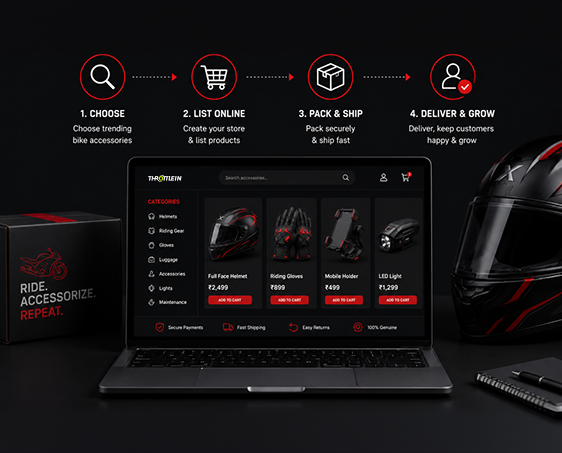
To sell bike accessories online in India, you need a GST registration, a seller account on a marketplace or your own store, clear product listings with compatibility details, and a fulfillment plan for shipping and returns. The whole setup can realistically be done in under a week. This guide walks you through every step, from paperwork to your first sale.
India's e-commerce market is valued at roughly ₹10.82 lakh crore and projected to reach ₹29.88 lakh crore by 2030 (DMI Finance, 2026). Bike accessories are a meaningful slice of that growth, with the India two-wheeler accessories market alone valued at USD 392.92 million in 2025 (IMARC Group, 2025). If you're sitting on inventory or running a shop and wondering how to take your bike accessories shop online, you're looking at a market that's already proven, growing, and underserved by sellers who actually understand the category.
Why Should You Sell Bike Accessories Online Right Now?
You should sell bike accessories online now because India's two-wheeler ownership base keeps expanding and digital retail is becoming the default discovery channel for parts and gear. Waiting means competitors capture customers who would have found you first.
Here's a number that should grab your attention: the India motorcycle accessories market is growing at a 6.2% CAGR through 2032, driven by safety mandates, customization demand, and rising disposable income (6Wresearch, 2026). That's not a fad. It's a structural shift in how Indian riders shop for crash guards, helmets, lighting, and luggage.
I've watched dozens of offline accessory shops make the jump online over the past few years. The ones that win aren't necessarily the ones with the biggest stores. They're the ones that get the basics right early: clean listings, fast fulfillment, and a platform that actually understands bike parts instead of treating them like generic SKUs.
What Do You Need Before You Start Selling Bike Accessories Online?
You need four things before you start: a GST registration, a PAN card linked to your business, a bank account for settlements, and product photos with accurate specifications. Skipping any of these will get your listings rejected or delayed during onboarding.
GST Registration: The Non-Negotiable First Step
If you sell goods through an e-commerce marketplace in India, GST registration is mandatory from your very first sale, regardless of your turnover (Zetapp, 2026). This is different from offline retail, where you only need GST once you cross ₹40 lakh in annual turnover. Marketplaces cannot activate your seller account without a valid GSTIN because they're required to collect Tax Collected at Source (TCS) on your behalf.
GST registration is mandatory for online accessory sellers because marketplaces report your transactions to the tax department, and an unregistered seller breaks that compliance chain. The process itself is fully digital. You apply on the GST portal using your PAN, get a Temporary Reference Number, upload your documents, and receive your GSTIN typically within 3-7 working days (GimBooks, 2026).
Documents You'll Need
PAN card of the business or proprietor
Aadhaar card for identity verification
Proof of business address (electricity bill, rent agreement, or ownership document)
Bank account proof (cancelled cheque or recent statement)
Passport-size photographs of the authorized signatory
Partnership deed or authorization letter, if applicable
If you're operating from home, that's fine. You can use your residential address as your principal place of business as long as you provide valid ownership proof or a no-objection certificate from family members (RegisterKaro, 2026).
How Do You Choose Where to Sell Your Bike Accessories Online?
You choose where to sell based on your product type and margins. Premium and branded gear performs best on category-specific platforms, while budget accessories do well on high-volume general marketplaces. Most serious sellers eventually run more than one channel.
This is the decision that separates accessory sellers who scale from ones who plateau. A general marketplace gives you reach but buries your listing among thousands of unrelated products. A niche platform built around riders gives you a smaller but far more relevant audience.
Selling on a Dedicated Bike Accessories Marketplace
Throttlein is built specifically for two-wheeler gear: helmets, jackets, bags, boots, lighting, exhaust systems, and rider protection. When you list here, every visitor is already shopping for exactly what you sell. The platform's seller program lets you onboard in 48 hours, with zero setup fees for your first 90 days and the lowest commission in the bike accessory category.
This matters more than it sounds. On general marketplaces, a buyer searching for a helmet might scroll past 200 unrelated results before reaching yours. On a category-focused platform, your helmet sits next to other helmets, jackets, and riding gear that the same buyer is comparing right now.
Selling on General Marketplaces
Amazon and Flipkart give you the widest possible reach across India. Amazon India sees over 295 million monthly visitors (Qikink, 2026), and that scale is hard to ignore if you have catalog depth. The trade-off is commission and competition. Combined platform costs (commission, closing fees, shipping, and ad spend) typically run 20-30% of your selling price on these platforms (Toolbaz, 2026).
Selling Through Your Own Website
Building your own store on Shopify or WooCommerce gives you full control over branding and customer data, with no commission cut to a third party. The catch is you have to drive your own traffic, which means investing in SEO, social media, or paid ads from day one. This works best as a long-term complement to marketplace selling, not a replacement for it in your first year.
How Do You List Your Bike Accessories for Maximum Visibility?
You list your bike accessories for maximum visibility by writing specific, compatibility-driven titles, using multiple high-resolution photos, and including exact technical specifications. A vague listing gets ignored. A detailed one builds buyer trust before they even click.
A definitional point worth remembering: a high-converting product listing is one that answers every question a buyer would ask before they even reach the checkout page. For bike accessories, that means bike model compatibility, material, weight, certification (BIS marking for helmets, for instance), and installation requirements.
What to include in every listing:
Product title with brand, model, and key feature (example: "Axor Apex Venom Full Face Helmet, ISI Certified")
Minimum 5 to 6 photos from different angles, including a size or fitment reference
Compatibility details (which bike models or handlebar sizes it fits)
Material and build specifications
Certification marks where applicable (ISI, BIS, ECE for helmets)
Clear return and warranty terms
From auditing accessory listings across multiple platforms, the single biggest conversion killer is missing compatibility information. A crash guard listing that doesn't specify the bike model it fits gets returned far more often, which hurts your seller rating over time.
What Pricing Strategy Works Best for Bike Accessories Online?
The best pricing strategy accounts for your full landed cost, every platform fee, and a healthy margin buffer for returns. Underpricing to compete on visibility usually backfires once fees and return costs eat into thin margins.
Here's the comparison that matters before you set a single price:
Cost Factor | Niche Marketplace (Throttlein) | General Marketplace (Amazon/Flipkart) | Own Website |
|---|---|---|---|
Commission | Lowest in category | 7-22% by category | None (payment gateway fee only) |
Setup time | 48 hours | 3-10 days | Days to weeks |
Audience relevance | High, rider-specific | Mixed, broad | Depends on your traffic |
Total effective cost per sale | Low | 20-30% (DigitalDawn, 2026) | Marketing cost + 2-3% gateway fee |
A healthy profit margin for Indian marketplace sellers generally sits between 15% and 35% after all fees and product costs (Toolbaz, 2026). If your calculated margin falls below that on a general marketplace, it's worth testing the same product on a lower-fee niche platform before assuming the product itself isn't profitable.
How Do You Handle Shipping and Fulfillment?
You handle shipping by choosing between self-fulfillment and platform-managed fulfillment, based on your order volume and storage capacity. Low-volume sellers usually start with self-shipping, while high-volume sellers benefit from platform fulfillment services that handle packing and delivery.
If you're shipping bulky items like top boxes, saddle bags, or full helmets, packaging quality affects both delivery cost and damage-related returns. Use rigid boxes with internal padding, and always include a fitting guide or instruction sheet inside for accessories that require installation, like crash guards or auxiliary lighting.
In my experience working with accessory sellers transitioning from offline shops, the single most common early mistake is underestimating return rates for fitment-sensitive products. Always state the exact bike models a product fits, both in the title and in a dedicated compatibility section.
What Marketing Actually Works for Bike Accessory Sellers?
What works best is a combination of platform-native visibility tools and content that speaks directly to rider problems. Generic product ads underperform compared to listings and content that show the accessory solving a specific riding issue.
Tactics that consistently move the needle:
Optimize your product title and bullet points around what riders actually search for (compatibility, certification, durability)
Run small sponsored ad budgets (even ₹2,000-3,000 to start) to establish initial ranking
Encourage early reviews by following up with buyers after delivery
Use clear, well-lit photos that show the product installed on an actual bike, not just on a white background
Cross-list complementary products (a helmet seller should also stock Bluetooth communication devices and navigation mounts)
Selling your bike accessories online is rarely about one big marketing push. It's about consistent listing quality and showing up reliably in front of buyers who already have intent.
How Long Does It Take to Get Your First Sale?
Most sellers see their first sale within one to two weeks of going live, assuming listings are complete and pricing is competitive. The exact timeline depends on the platform's existing traffic and how well your product matches active buyer searches.
On a niche platform with built-in rider traffic, like Throttlein, sellers often see faster initial movement because the audience is already searching within the category. On general marketplaces, expect a slower ramp as your listing builds review history and search ranking, especially in the first month.
A realistic expectation, based on patterns across accessory sellers I've worked with: budget two to four weeks to validate a product before drawing firm conclusions about its performance on any given platform.
Conclusion: Start Small, List Well, Scale With the Right Platform
Selling bike accessories online in India in 2026 isn't complicated, but it does require getting the fundamentals right from day one. Get your GST registration sorted first, since no marketplace will activate you without it. Pick a platform that matches your product type rather than defaulting to the biggest name you've heard of. Then list with real compatibility detail, because that single habit separates accessory sellers who get repeat buyers from ones who get returns.
If you carry premium gear, branded helmets, or technical accessories, Throttlein gives you direct access to riders who are already shopping for exactly what you sell, with the lowest commission in the category and 48-hour onboarding. If you're testing budget products at scale, layer in a general marketplace once you've built initial reviews on a focused channel.
The market is growing steadily and isn't going to wait for you to figure this out at your own pace. Your next move is simple: gather your GST documents, pick your first platform, and get your top five products listed this week. Start at throttlein.com/sell if your catalog fits the rider gear category, and build from there.